Puthukkudiyiruppu. Before you come.
The Victory Monument and war museum beside Nanthi Kadal lagoon — the ground where Sri Lanka's 26-year civil war ended in May 2009.
| Time needed | 90 minutes |
|---|---|
| Do this | Go with a local guide from Mullaitivu town if you possibly can. The signage covers what a thing is; a guide covers why it mattered, and on this particular ground that gap is the whole visit. Budget the time for the bunker complex too, not just the monument. |
Pulled from what guests actually report on this page — confirm the price at the gate, official fees change without notice.
Go with a local guide from Mullaitivu town if you possibly can. The signage covers what a thing is; a guide covers why it mattered, and on this particular ground that gap is the whole visit. Budget the time for the bunker complex too, not just the monument.
Puthukkudiyiruppu is where the war finished. It is not a battlefield you walk across — it is a compact memorial site beside Nanthi Kadal lagoon, holding the Victory Monument unveiled in 2019, an open-air war museum of captured weapons and improvised armoured vehicles, and the preserved bunker complex of the LTTE leadership. People come for the same reason they visit any site of recent history: to stand on ground they have only read about. It is the single most important post-war site in the north and, for many visitors, the emotional centre of a whole northern trip.
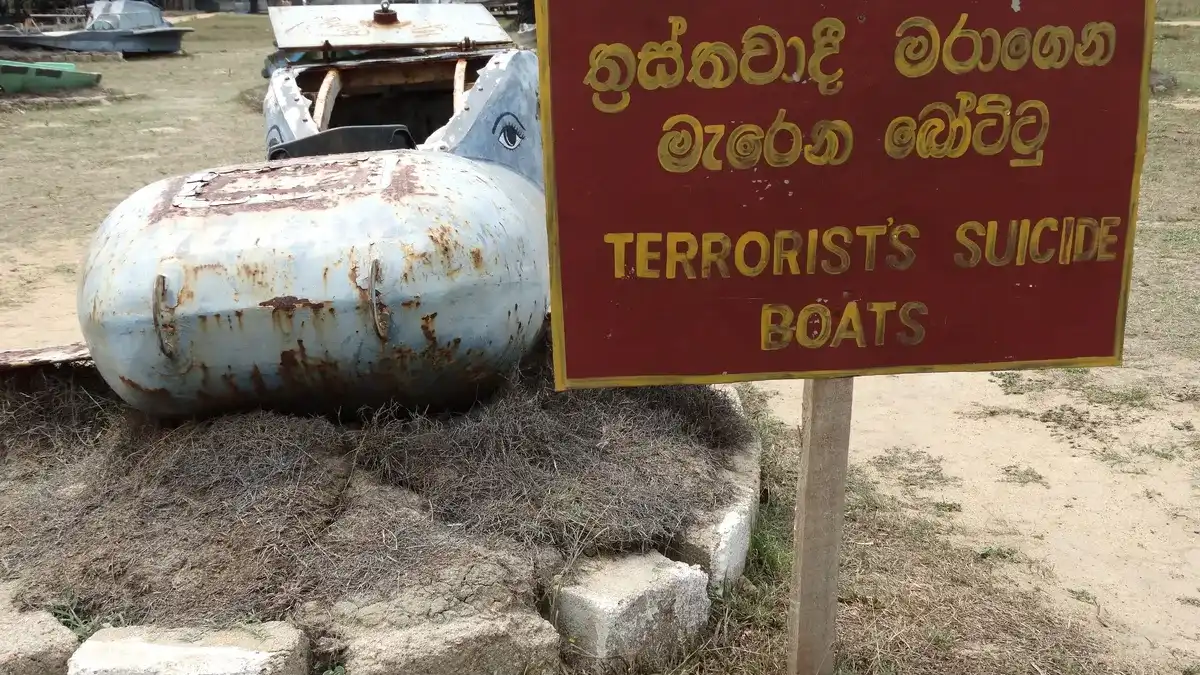
Set expectations correctly and this place delivers. It is not a polished interpretive museum with dioramas and audio guides — the museum is largely open-air, the signage is thin, and the exhibits are displayed rather than explained. The strength of the site is that things are still there: the four-level underground bunker with its armoured doors, the escape tunnel, the sea-tiger training pool with its glass observation port, and the captured vehicles lined up in the open. What you get out of a visit is close to proportional to how much you already know coming in.
There is a visitor information booth on site with a large map marking the important locations of the final stage of the operation, labelled in English and Sinhala. The sites have been open to the public without prior permission since August 2011, so no escort or permit is needed — that was only true in the war's immediate aftermath. Expect a working memorial rather than a curated attraction: hawkers outside, a canteen, school groups on holidays, and long stretches where you are alone with the bunkers. Photography is generally fine, but this is a memorial ground first, so read the room before you start posing.
The site is beside Nanthi Kadal lagoon, which is itself significant — it is the shallow water where the final phase played out. The combination of lagoon, monument, museum and bunkers makes a natural half-day. Come with a local guide from Mullaitivu town if you can arrange one; the difference between walking past a bullet-scarred wall and understanding it is usually one person who knows what they are looking at.
- There is no ticket gate. The site has been open to visitors without prior permission since August 2011, and there is no reliable published admission charge — treat any fee quoted online as unconfirmed and confirm on arrival.
- Best visited early morning (7-9 AM), before the heat builds and before school and tour groups arrive. School holidays are notably busier.
- It is roughly 17 km from Mullaitivu town on the Paranthan-Mullaitivu road, beside Nanthi Kadal lagoon. A tuk-tuk each way is the usual approach for independent travellers.
- Allow 90 minutes to 2 hours if you want to see the monument, the museum and the bunker complex properly. An hour is enough only if you skip the bunkers.
- Bring water and sun protection — much of the site is open ground with little shade, and facilities nearby are basic.
- This is a memorial ground with real political and emotional weight for Sri Lankans of every community. Dress and behave accordingly, and ask before photographing people.
Have a specific question about Puthukkudiyiruppu?
Ask BYC — honest answers from 300,000+ real guest reviews.