Is Dambulla Worth Visiting? Cave Temple & Where to Stay 2026
You have three nights in the Cultural Triangle and a map that keeps pulling you in three directions: Sigiriya to the north, Polonnaruwa to the east, Minneriya's elephants somewhere in between. Almost everyone asks the same thing before they book — is Dambulla worth a stay in its own right, or is it just a road junction you pass through on the way to somewhere better? It is the largest town in this part of the island, it holds a UNESCO World Heritage cave temple that most visitors rank alongside Sigiriya, and it sits at the crossroads where the Kandy road meets the Anuradhapura and Trincomalee highways. The honest answer is more useful than either "yes" or "no".
Is Dambulla worth visiting? The short answer
Yes — and for a specific kind of traveller, it is the smartest base in the whole region. Dambulla is worth visiting as a one-to-two-night stop if you want the Cave Temple (Rangiri Dambulla Rajamaha Viharaya), easy access to Sigiriya, Polonnaruwa and the elephant parks, and a town with real local life rather than a single strip built for tourists. It is less compelling if you are chasing a beach-and-sunset holiday, because there is no sea here at all — it is dry-zone scrub, paddy and rock, roughly at the island's geographical centre. What surprises people who do stop is the value. Across 8,520 verified guest reviews of Dambulla properties, the average score sits at 8.83 out of 10 — higher than Colombo, Kandy, Nuwara Eliya or Galle — and the best small hotels and homestays routinely score above 9.3. You get strong, well-run places to sleep at prices the coast stopped offering years ago.
What's worth doing in and around Dambulla
- The Cave Temple (Rangiri Dambulla Rajamaha Viharaya). The reason you are here. Five caves carved into a 160-metre granite outcrop, holding more than 150 Buddha statues and around 2,100 square metres of painted murals that are over two thousand years old in places. The climb is a short, steep staircase — 10 to 15 minutes at an easy pace — not the multi-hour effort of Sigiriya. This is the best-preserved cave temple complex in Sri Lanka and, for many travellers, the single most impressive religious site on the island.
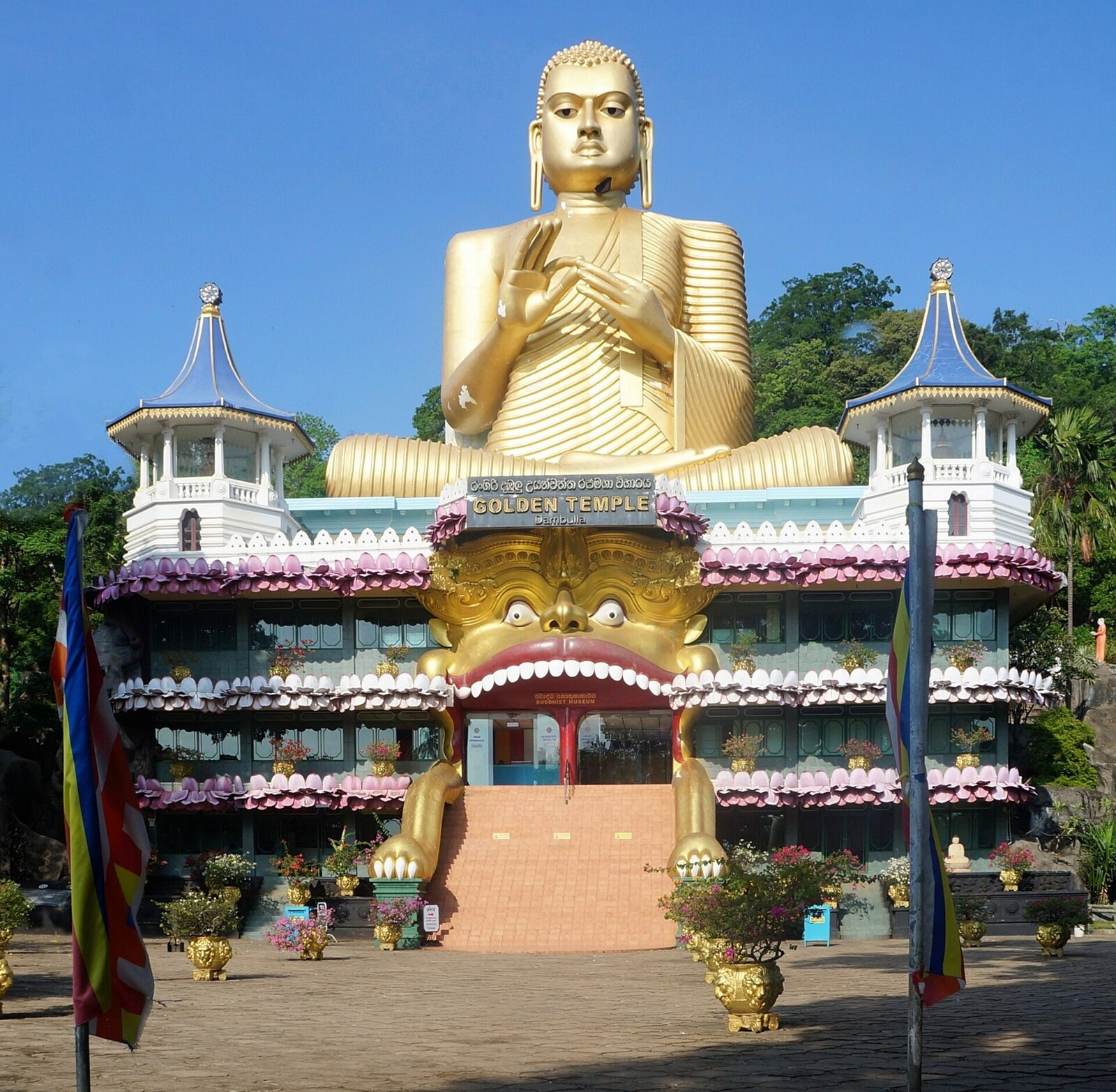
- The Golden Temple at the foot of the rock. The oversized golden Buddha and the gaudy, touristy museum entrance below the caves. Opinions split hard on it; walk through, don't linger. It is included in the same visit and takes ten minutes.
- Sigiriya Rock Fortress, 20–25 minutes away. The 5th-century sky palace is the region's headline act and pairs naturally with a Dambulla base. Go first thing in the morning — by 10am the staircase is baking and the queue for the final ascent to the summit is long.
- Minneriya and Kaudulla national parks, 30–45 minutes away. The "gathering" of wild elephants around the Minneriya tank is one of Asia's great wildlife spectacles, best from roughly June to September when the water pulls the herds together. Afternoon jeep safaris are the norm here.
- Polonnaruwa's ancient city, about 1.5 hours east. The best-preserved ancient capital, easily seen by bicycle. Many people day-trip it from Dambulla rather than move hotels.
- The Dambulla Dedicated Economic Centre. One of the country's biggest wholesale vegetable markets, and a genuinely Sri Lankan morning — towering piles of produce and the real rhythm of the region. Go early, before 7am if you can.
- Ibbankatuwa Megalithic Tombs and the Rangiri craft village. Smaller, quieter stops: a prehistoric burial site a few kilometres out, and a workshop village where you can watch pottery, wood-carving and brasswork being made.
Getting around Dambulla
Dambulla's real advantage is that it is the region's transport hub. The town sits where the A9 Kandy–Jaffna road crosses the A6 to Anuradhapura and Trincomalee, which makes it the cheapest jumping-off point in the Cultural Triangle.
- From Colombo: air-conditioned express buses run to Dambulla for about LKR 450–600 (US$1.50–2) in around 4 hours. A private car or taxi transfer is roughly US$70–90 and takes 3.5–4 hours.
- From Kandy: buses take about 2 hours for around LKR 200–300 (US$0.70–1). This is the most common onward leg.
- From Negombo or the airport: around 3 hours by road; a private transfer is US$55–75.
- To Sigiriya: a tuk-tuk from Dambulla town to the Sigiriya entrance runs LKR 1,500–2,500 (US$5–8), or a local bus for under LKR 100. Many Dambulla hotels will arrange a driver for the day.
- To Polonnaruwa: buses run frequently from Dambulla's bus stand for roughly LKR 150–200 (US$0.50–0.70); a hired car for the round trip is US$35–50.
- To Minneriya: tuk-tuk or a shared safari jeep, US$20–35 return plus the park fee.
What to avoid: don't assume a train. Dambulla has no useful rail connection for these sites — the town works on buses and hired vehicles. Avoid paying a "day rate" to a driver who quotes per stop; agree a flat fee for the whole day up front, and confirm whether park entry fees are included (they are separate, and the jeep operator usually does not pay them).
What to budget in Dambulla
Dambulla is one of the better-value places on the standard tourist circuit. A realistic mid-range day, per person:
- Accommodation: US$25–45 for a good double room or family homestay; US$70–120 for a resort with a pool; US$12–20 for a clean budget guesthouse. Rooms here are noticeably cheaper than the same standard on the south coast.
- Meals: US$6–12 a day. A rice-and-curry lunch or dinner at a local restaurant is LKR 400–800 (US$1.30–2.70); a tourist-restaurant main is LKR 1,200–2,000 (US$4–7). Breakfast is often included at homestays.
- Activities: Cave Temple entry is LKR 1,500–2,000 (about US$5–7) for foreign adults; Sigiriya is the big-ticket item at around US$30–37; Minneriya park fee plus jeep is roughly US$45–65 per group.
- Transport: US$10–20 a day if you mix tuk-tuks and buses; US$45–70 a day if you hire a car and driver.
All-in, a comfortable mid-range day in Dambulla lands around US$60–90 per person, or US$35–50 if you travel lean on buses and eat local. Two nights covers the caves, Sigiriya and one safari comfortably.
Watch out for
- Safari "elephant gathering" promises all year. The famous mass gathering is seasonal — roughly June to September around Minneriya, often shifting to Kaudulla or Hurulu Eco Park at other times. In the dry months you may see plenty of elephants, just not the spectacle. Ask which park is actually holding water and herds on your dates before you book a jeep.
- Unlicensed "guides" at the cave temple car park. You do not need a guide to climb the caves — the site is self-explanatory. If you do want one, agree the price for the whole tour first, in writing or very clearly, and be aware the temple's own signage is adequate.
- Shoulders-and-knees dress rules. The Cave Temple is an active place of worship. Cover shoulders and knees, and remove shoes and hats at the entrance. There is a shoe deposit point; keep a small note for the token.
- Paying twice for the "Golden Temple". The large golden Buddha and museum area below is often free to walk through when the caves are open — do not accept a separate "entrance fee" for it before you have bought your cave temple ticket.
- Rooms marketed as "near Sigiriya" that are actually in Dambulla. That is fine — but check the real distance, because a 20-minute drive each way twice a day eats into your time. Conversely, a "Dambulla" listing can be 8km out of town on the Sigiriya road, which is quiet and pleasant but needs a vehicle for dinner.
- Midday heat. The Cultural Triangle is hot and dry. Do the caves and any climbing early; keep the middle of the day for a long lunch or a pool.
Good to know
- Best time to visit: the Cultural Triangle is dry-zone and is at its most comfortable from roughly December to March, with a second good window in July–September (the same months the Minneriya elephant gathering peaks). This is also one of Sri Lanka's two monsoon patterns — but the north-central dry zone is the least affected part of the island, so Dambulla is a genuinely year-round stop.
- Timing the caves: the temple is open daily from about 7am to 7pm, with last tickets usually sold around 5pm. Arrive by 7:30–8am for cool air, soft light in the murals and almost no crowds. Late afternoon is the second-best window.
- How long: one full day covers the Cave Temple and either Sigiriya or a safari. Two nights is the sweet spot for the caves plus a park plus Polonnaruwa. Three nights only pays off if you are a slow traveller or a wildlife obsessive.
- Booking: Dambulla has plenty of rooms, so you rarely need to book far ahead outside December–January and the local Poya long weekends. Booking 2–3 days ahead is normally enough for the popular small hotels; the top-scoring homestays do fill in peak season.
- Cash: smaller guesthouses and local restaurants prefer cash (LKR). Bring enough for a few days; ATMs exist in town but are not on every corner.
- Day-trip, don't double-book: Dambulla, Sigiriya and Habarana are close enough that you should choose ONE base and day-trip the others rather than moving hotels three times.
Where to stay in Dambulla
These are drawn from the properties in our 8,520-review Dambulla dataset, each with a reason that shows up again and again in guest feedback.
- Simoya Nature Park — the highest-rated of the larger properties in our data at 9.82/10 across 395 reviews. Guests repeatedly praise attentive staff, flowers and photo gifts left in the rooms, spacious rooms and a strong breakfast. A nature-set pick for travellers who want a resort feel without a resort price.
- Blue Mountains View — 9.34/10 across 537 reviews, one of the most-reviewed quality options in the area. The consistent theme is calm: reviewers love that it sits out of town, quiet and relaxing, with hosts (Pradeep and family) who are singled out by name for their care. Best for people who want peace and don't mind being a short drive from the centre.
- Kandalama Lodge — 9.69/10 across 259 reviews, clustered near the famous Kandalama lake area. Reviews highlight first-class, comfortable facilities and staff who make everything "flow seamlessly". A good mid-to-upper choice with a scenic setting.
- The Green Village Dambulla — 9.41/10 across 306 reviews. Guests point to clean, bright rooms, strong working AC, a good breakfast and hosts who will book a tuk-tuk or arrange your onward plans. Excellent value for couples and small families.
- Sayare Inn — 9.47/10 across 202 reviews, a family-run homestay that reviewers describe as superb, with huge, tasty breakfast and dinner portions and kind, attentive hosts. The pick if you want a warm local homestay rather than a hotel.
If you would rather be nearer the rock itself, the Sigiriya side of the triangle has its own deep bench of high scorers — but base yourself once and day-trip; see our guide to choosing between Sigiriya and Habarana.
The bottom line
Dambulla earns its place on a Sri Lankan itinerary, and not just as a place you sleep between Sigiriya and Kandy. The Cave Temple alone justifies the stop, the transport links make the whole Cultural Triangle cheaper and easier, and the accommodation — 8,520 reviews averaging 8.83, with standout stays above 9.4 — is some of the best value on the island. Give it two nights, do the caves at dawn, day-trip the rock and the elephants, and you will understand why this crossroads town keeps quietly outscoring the famous names around it.
Last updated: October 2026. Prices are indicative and change with the exchange rate; confirm temple ticket prices and park fees locally before you travel.
Have a specific question about your Sri Lanka trip?
Ask BYC at byc.lk — Free and honest. Some links are affiliate links and never change our advice.
Ask BYC Your Question →