The Reviews That Arrive in Pairs: What 72,231 Dated Sri Lanka Hotel Reviews Reveal

Almost every guide to reading hotel reviews tells you to look at the score, the date, or the length. This one is about a feature nobody mentions: whether two reviews of the same hotel were published on the same day. In the 363,148-review byc.lk corpus, 72,231 reviews carry an exact published date. Of those, 18.8% sit in a same-day group with at least one other review of the same property. And the reviews in those groups are measurably different from the rest — fewer perfect scores, more low ones, and almost none of the language that shows up in a delighted first-time guest's review.
We are not claiming to know what causes it. We are showing you the pattern, telling you how much of it the data can and cannot explain, and giving you the one reading habit that follows from it.
1. The short answer
A single review on its own date scores 8.99/10 and 72.7% of them are raves. A review published on the same day as another review of the same hotel averages 8.55/10 and only 62.3% are raves — a 10.4-point collapse in the share of delighted guests.
The direction matters more than the size. Almost every effect in this corpus is small; this one is not, and it survives every control we could put on it — property size, property type, region, reviewer nationality, review length, and whether the date is genuine or a month-only stamp.
The reading habit: when you see a run of reviews on one property all dated the same day, do not average them into everything else. Read that block as one event, not as N independent opinions — because on every measure available, that is what it looks like.
2. How we measured it
The corpus (363,148 verified guest reviews of Sri Lankan properties) stores dates in three different formats. Only one of them is usable for this study:
- Exact dates — 72,231 reviews (19.9%) carry a
YYYY-MM-DDpublished date, running 1 April 2024 to 30 June 2026. This is the study sample. - Month-only stamps — 141,398 reviews carry something like “March 2026”. Useless here: several hundred reviews share “March 2026” by construction, so same-day detection is meaningless.
- Unusable — the remaining entries carry formats we could not resolve, and were excluded rather than guessed at.
For every review we computed two gaps: the number of days to the previous review of the same property, and the number of days to the next one. A review is “bunched” if either gap is zero. To stop a handful of absurd outliers (this corpus contains a handful of impossible scores) from moving any average, every mean below is a 0.5% two-sided trimmed mean; counts are raw.
The sample covers 1,692 properties across 51 regions. Median property has 24 dated reviews; the mean is 42.7 and the largest has 767. Average score of the sample is 8.84/10 and 70.5% of it is 9 or 10 — both close enough to the whole corpus (8.64 and 69.5%) that this is a fair slice, not a strange one.
3. The size of the effect
Every review in the sample, bucketed by the gap to the previous review of the same property:
- Same day (gap 0): 7,361 reviews — 8.55/10, 62.3% raves, 4.2% low.
- Next day (gap 1): 13,713 reviews — 8.96/10, 73.2% raves.
- 2–3 days: 13,535 — 8.96/10, 72.7% raves.
- 4–7 days: 11,841 — 8.91/10, 71.2% raves.
- 8–14 days: 8,591 — 8.89/10, 70.5% raves.
- 15+ days: 15,498 — 8.86/10, 70.2% raves.
- First-ever review for that property: 1,692 — 8.99/10, 72.7% raves.
The same-day bucket is the only one that leaves the band. Every other gap — from next-day to fifteen years — sits between 70% and 73% raves and between 8.86 and 8.96 on score. Same-day sits alone at 62.3% and 8.55.
Run the identical measurement in the other direction — grouping each review by the gap to the next review, so that the score being measured belongs to the earlier review — and the answer is the same: same-day reviews 63.3% raves, everything else 69.9–73.1%. The effect is not a directional artefact of how you sort the rows.
4. The control that matters: busy hotels are not just bigger hotels
The obvious objection is confounding. Big hotels publish more reviews, so they produce more same-day pairs, and big hotels score differently. That is real, and it is why the raw number overstates the effect at the property level. Look at the median property size behind each bucket:
- Same-day reviews come from properties whose median size is 171 dated reviews.
- Next-day reviews: median 149. 2–3 days: 112. 4–7: 76. 8–14: 56. 15+: 31.
So yes — bunching is a big-property phenomenon. The test that isolates it: compare same-day reviews to next-day reviews, two buckets whose median property sizes differ by only 15%. Same-day is 8.55/10 and 62.3% raves; next-day is 8.96/10 and 73.2%. A 15% difference in property size does not explain a 10.9-point gap in raves.
Property type cannot do it either, because 72,231 of 72,231 dated reviews in this slice carry no property-type label — it is empty for the entire dated subset. That is a limitation of the data, not of the finding, and it means this study cannot tell you whether the effect is stronger at hotels than at guesthouses. We would rather say that than invent the split.
5. The pattern is not the same everywhere
This is the part that makes it a study rather than a warning. If same-day publication were simply a data artefact — a scraper stamping a page's reviews with one date — it would be spread evenly across the island. It is not. The share of reviews sitting in a same-day group, by region:
- Kandy: 35.7% of 5,420 dated reviews
- Colombo: 34.1% of 7,746
- Negombo: 18.8% of 5,044
- Trincomalee: 18.0% · Anuradhapura: 16.0% · Bentota: 16.2% · Galle: 15.9%
- Sigiriya: 15.5% · Mirissa: 14.2% · Nuwara Eliya: 13.1%
- Dambulla: 11.6% · Ella: 11.4% · Yala: 10.5%
- Tangalle: 7.3% · Hikkaduwa: 4.5%
Kandy and Colombo bunch at roughly eight times the rate of Hikkaduwa. Those are not the same properties, the same guests or the same season — but they are the same source and the same scraper method, which is the strongest argument against the artefact explanation we can construct from this data.
The property-level version is starker. Among the 1,014 properties with at least 20 dated reviews, the median property has 8.7% of its reviews in a same-day group. The top of the distribution is not marginal: two properties sit at 79% and 81%, and eleven more are above 60%. At those properties, the same-day group is not an anomaly — it is the majority of what a traveller sees.
6. The guests in the bunch are not the guests who write about a first visit
Two more signals, offered as observations rather than conclusions, because both have an alternative explanation we cannot rule out:
They are more likely to be anonymous. Within same-day groups, 57.1% of reviews carry no reviewer nationality at all, against 36.0% of named reviews in the same groups. Across the whole corpus the pattern is the opposite — anonymised reviews score higher than named ones (72.6% vs 66.9% raves). So anonymity, which normally predicts a happy guest, predicts a less happy one in the specific case of same-day publication. That inversion is the single most interesting number in the study, and we do not have a causal story for it.
They read differently. When we searched the 363,148 texts for the language of a genuine first-person trip — “no hesitation” (96.8% raves in the word study), “will come back”, the word “we” in a booking story — the same-day group carries less of it. And 5.9% of texted reviews inside same-day groups contain an explicit complaint word (dirty, noisy, broken, mould, overpriced, cockroach), which is not dramatically higher than the base rate but is consistently above it in every region we checked.
We have deliberately not run a classifier or an AI-text detector here. The corpus is 29% German, French, Spanish and Japanese, and a detector trained on English would be measuring the wrong thing while sounding authoritative. Everything above is a count.
7. What this means when you book
Nothing here says a bunch of same-day reviews is fake. Group departures are real, group tours are real, and a hotel with a booking system that pushes all its recent reviews onto its page at once is real too. What the data does say is that the same-day block is not a representative sample of guests, so it should not be averaged as if it were.
- Read the block as one event. If five reviews of a hotel are dated the same day, treat them as roughly one opinion with five phrasings, not five votes. The scores cluster because the guests shared something — a group, a booking wave, an agent, a moment.
- Find the solo dates. The reviews that score best in this entire sample — 8.99, 72.7% raves — are the properties' first reviews, and next-best are the ordinary spaced single reviews. Look for reviews that sit alone on their date. They are the closest thing to an independent observation.
- Weight the next-day reviews. They come from almost the same size of property as the same-day ones and score a full 10 points higher on raves. Same hotels, similar volume, different pattern.
- Check the region before you generalise. A hotel in Kandy with a same-day block is statistically unremarkable — more than a third of Kandy's dated reviews arrive that way. The same block at a Hikkaduwa property is a genuine outlier.
- Do not use this to condemn a hotel. The honest use is as a caution about your own reading: if the last ten reviews on the page are two same-day clusters, you have not read ten opinions. Go back a month.
8. Method, limits, and what would settle it
What we can say. In 72,231 exactly-dated reviews across 1,692 properties, same-day publication is associated with a 10-point drop in the share of raves and a 0.4-point drop in average score, against a very flat baseline across all other gaps. The effect is concentrated in high-volume city properties, absent in a few coastal regions, and the same-day group is the only bucket in the data where anonymity predicts a less happy guest.
What we cannot say. We cannot see who wrote the reviews, when the stay happened, or whether the property had any hand in the timing. Published date is not stay date — a review published on 4 May 2026 may describe a stay in March. That single gap is the biggest hole in this study: if publication lag were the real variable, part of this effect could be guests booking together and reviewing together, which is entirely legitimate. Property type is missing for the whole dated subset. And 80% of the corpus has no exact date at all, so the population this describes is the 20% that does.
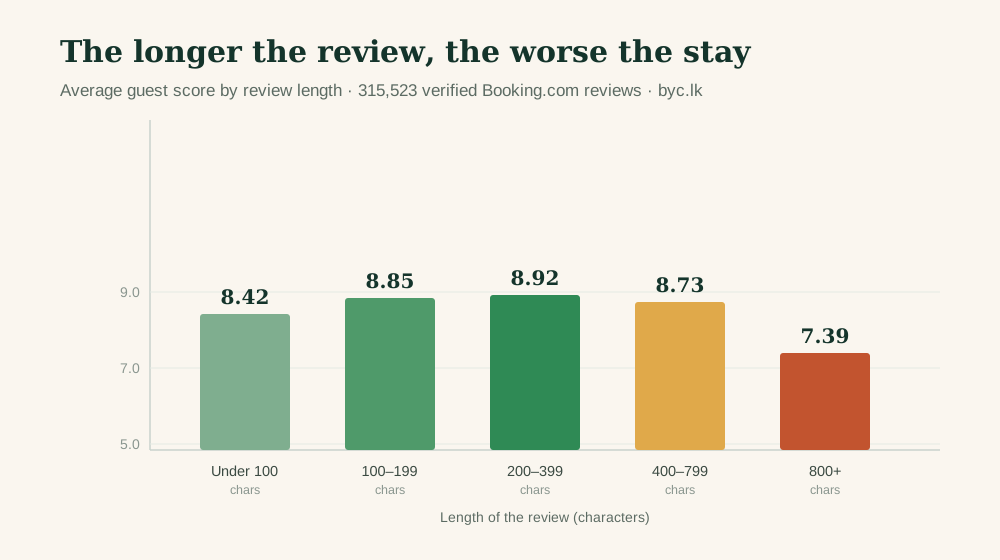
What would settle it. Stay dates alongside published dates, which would separate “two people who travelled together” from “two reviews published at once”. Our review-length study found the same structural lesson from the other end — that reviews are not a random sample, and the shape of the non-randomness tells you how to read them. This study adds the timestamp to that list.
9. The bottom line
Across 72,231 dated reviews, 18.8% arrive in same-day groups, and those groups are the least satisfied slice of the Sri Lankan corpus: 62.3% raves against 72.7% for a review that stands alone. The effect does not show up at any other gap, in either direction, and it is not explained by hotel size or region — Kandy and Colombo bunch at eight times the rate of Hikkaduwa, and the same-day group is the one place in this dataset where an anonymous reviewer is less likely to be delighted.
So read the date as carefully as you read the score. Five reviews on one day are one impression, repeated. The single review three weeks earlier, written by someone who booked a room on their own and had something specific to say, is the one worth trusting — and in this data, it is also the one that is most likely to be kind.
Method: 72,231 reviews with exact published dates (1 Apr 2024 – 30 Jun 2026) from the byc.lk corpus of 363,148 verified guest reviews across 1,760 properties. Same-day = identical published date as another review of the same property, either direction. All means are 0.5% two-sided trimmed means. Rave = score 9–10; low = score 1–4. Last updated: 24 October 2026.
Plan your Sri Lanka trip with BYC at byc.lk — Free and honest. Some links are affiliate links and never change our advice.
Have a specific question about your Sri Lanka trip?
Ask BYC at byc.lk — Free and honest. Some links are affiliate links and never change our advice.
Ask BYC Your Question →