Do People Speak English in Sri Lanka? What 220,782 Guest Reviews Reveal
Short answer: yes. English is one of Sri Lanka’s official languages, it is taught in schools from primary level, and nearly everyone you will deal with as a traveller — guesthouse hosts, tuk-tuk drivers, guides, waiters, ticket clerks — speaks enough of it to do business. The question travellers actually mean when they ask this is narrower and more useful: will I be understood, and will I be able to understand? The answers diverge sharply by who you are and where you are.
We went looking for the real answer in a place nobody else looks: what guests write after the stay. Across 220,782 verified guest reviews of Sri Lankan properties in the BYC corpus, language comes up far less often than you would expect — and when it does, it splits down the middle.
The short answer, in numbers
Out of 220,782 verified reviews, only 715 (0.32%) mention the ability of anyone to speak English. Broadening the net to communication of every kind — English, gestures, translate apps, “we couldn’t understand each other” — brings it to 2,924 reviews (1.3%). Everything else on this island, in the words of the people who were actually there, is about beds, breakfast, views, rain, tuk-tuk fares and whether the hot water worked.
That silence is the headline. Language is not a top-ten thing that goes wrong on a Sri Lanka trip. When it does appear, it appears at the extremes:
- 345 reviews explicitly praise the English — “spoke very good English”, “excellent English”, “a good source of information”. Average score: 8.78/10.
- 220 reviews explicitly criticise it — “the cleaner doesn’t speak English”, “limited English”, “hard to communicate”. Average score: 3.73/10.
- The 715 English-mentioning reviews average 6.92/10, against 8.56/10 for the corpus as a whole — a full 1.6 points lower.
Read those two numbers together and you get the practical rule that this whole page is built on: in a good stay, English is a bonus that people mention warmly. In a bad stay, English is a symptom. It is almost never the reason a trip goes wrong — it is what you notice once other things already have.
The two clusters, side by side
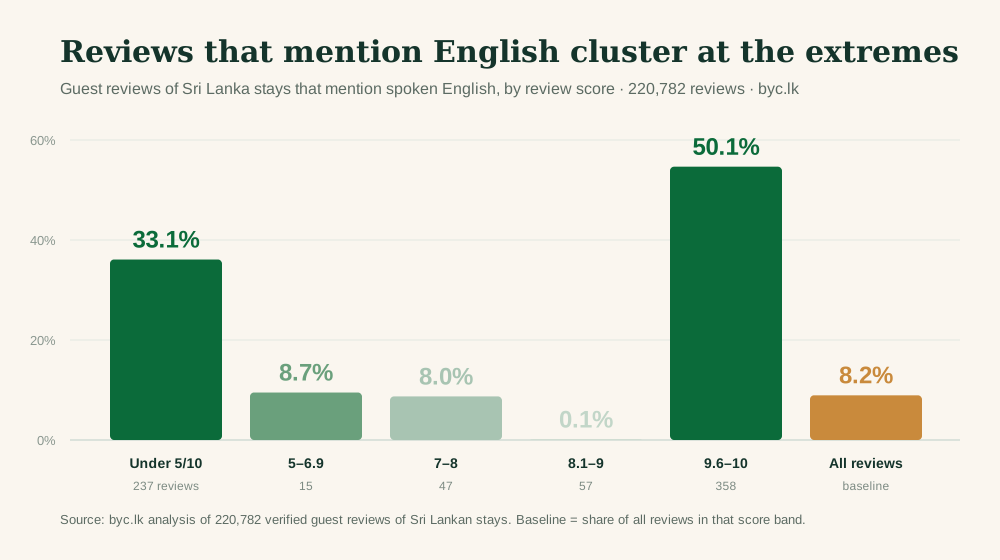
Reviews that mention spoken English, grouped by the score the guest gave. Source: byc.lk analysis of 220,782 verified guest reviews.
The chart is the surprising part. Of the 715 reviews that mention English, 33.1% score the stay below 5 out of 10, against a corpus baseline of 8.2% — four times the expected rate. Another 50.1% score it 9.6 or above, which is exactly the corpus average. The score bands in between are almost empty: 7-to-8 is 0.34x as common among English-mentioning reviews as in the corpus overall; 8.1-to-9 is 0.43x. Nobody writes about language after an average stay. They write about it after a 10 and after a 2.
Where English is not in question
Sri Lanka has three languages worth knowing about: Sinhala (about 75% of the population, the majority language in the south, centre and west), Tamil (about 15%, and the majority language in much of the north and east), and English, which is a link language — the common tongue between the other two and the one used in tourism, business and higher education.
In practice, at the level a visitor operates, you will not have a communication problem in the places you spend most of your trip:
- Hotels, guesthouses and homestays. Whoever checks you in speaks English. This is the single most reliable English-speaking interaction of any Sri Lanka trip, and the review data confirms it: when a property is praised for English, it is nearly always the host, the manager or the owner.
- Airport, railways and bus stations. Signage is in English and Sinhala (and Tamil in the north and east). Ticket counters staffed for foreigners speak English.
- Restaurants and cafés in tourist areas. Menus are in English; ordering is not an issue.
- Guides, drivers, tuk-tuk drivers in tourist towns. English is the working language of the tourist economy, from Arugam Bay to Nuwara Eliya. It is how they earn.
Guests rated English highest, relative to the number of reviews in the region, in Polonnaruwa (0.89% of reviews mention it), Dambulla (0.55%), Arugam Bay (0.44%), Trincomalee (0.40%), Yala (0.39%) and Anuradhapura (0.47%). These are the culture-and-safari stops where a host who can explain the ruins, arrange a jeep or talk you through the day adds real value — and where guests notice it enough to write it down. Polonnaruwa is the stand-out: of its 34 English-mentioning reviews, 27 are positive and exactly one is negative.
What the complaints are actually about
The 220 negative reviews are worth reading closely, because they are almost never about the country. They are about one specific role at one specific kind of property:
- The cleaning or support staff, at a large hotel. The recurring sentence is a version of “the cleaner doesn’t speak English” — written at a big property where the guest needed something fixed, and the person who arrived could not discuss it. At a 20-room hotel, front-desk English does not help you when the person who comes to your room does not have it.
- A mismatched booking, described through language. When a guest arrives and the room is not what they booked, and nobody can explain why or fix it, the language gap becomes the story of the review. In our sample, several of the lowest-scoring English complaints are attached to exactly this sequence.
- A property that promised more than it delivered. “The hotel was not like the pictures” and “the staff barely speak English” appear together more often than either appears alone.
- A genuine rural-area gap. In remote villages, small family-run places and some very cheap guesthouses, English can be thin. The data is honest about this — but it is a much smaller effect than the internet suggests.
Notice what is not in that list: not the airport, not the trains, not the guides, not the restaurants, not the towns. The problem, where it exists, is concentrated inside properties at the budget and mid-market ends, and it is usually a service-recovery problem wearing a language costume.
Who notices this most
One of the more interesting patterns in the data: the guests who write about English in Sri Lanka are overwhelmingly not the guests whose first language is English. Of the 715 reviews, the nationalities that appear are dominated by travellers from India, Japan, China, Malaysia, Bangladesh and continental Europe — the countries where an English-speaking host is a genuine convenience rather than a baseline assumption.
If English is not your first language, this is the most useful thing on the page: your English will work here. Sri Lankan English is used as a link language every day between Sinhala and Tamil speakers, so people are practised at handling accents and at simplifying. Guests report the same thing repeatedly — patient hosts, slow clear speech, and a genuine willingness to get to the point of what you need.
If English is your first language, you can expect less friction than almost anywhere in South or Southeast Asia. The one thing to plan for is accent: Sri Lankan English has its own rhythms, and it will take you a day to tune into. That is a matter of hours, not a barrier.
How to travel if you want zero friction
The review data gives a clear playbook. None of this is about learning Sinhala or Tamil — useful as a few words are.
- Book small, personally-run properties. The English-praise in this corpus is overwhelmingly attached to homestays, guesthouses and owner-run villas, not to big hotels. Small properties also appear far less often in the complaint cluster, because the person you need to talk to is the person who owns the place.
- Put requests in writing, in the app. Booking messages are text, and text dodges the accent problem entirely. Confirm the room type, the view, the transfer and the check-in time by message before you arrive — this is also the fix for the single most common complaint cluster above.
- Use the translate apps freely. Sinhala and Tamil both work reliably in Google Translate and Apple Translate, including camera translation for menus and signs. Download the languages offline before you fly; rural data can be patchy.
- Ask prices in writing or on a calculator. Tuk-tuk fares are the classic communication trap — not because of language, but because the price is negotiable. Type the number on your phone and show it. Agree before you get in.
- Learn four words. Ayubowan (hello/welcome, Sinhala), istuti (thank you, Sinhala), vanakkam (hello, Tamil) and hari (OK). They cost nothing and change the temperature of every interaction.
- In the far north and east, expect Tamil first. Jaffna, the Jaffna Peninsula and parts of the east run in Tamil rather than Sinhala; English still works with hosts, drivers and hotel staff, and this is a region where guests specifically praise how helpful and communicative people are — 19 of Jaffna’s 26 English-mentioning reviews are positive.
GOOD TO KNOW
- English is an official language of Sri Lanka — written into the constitution alongside Sinhala and Tamil since 1987, and the language of the courts, banking and higher education in practice. It is not a foreign language that people picked up from tourists.
- The north and east are Tamil-speaking. This is the trip-planning fact that matters most and is most often missed. Signage, place names and local conversation in Jaffna and much of the east will be in Tamil. English still functions with anyone in the visitor economy.
- The data undercounts nothing important by being quiet. 220,782 reviews, and language is mentioned in 715 of them. If English were a genuine, widespread problem on this island, it would show up on thousands of pages — the way rain, wifi and breakfast do.
- Score matters more than the language comment. Before you read a “staff don’t speak English” line as a red flag, look at the property’s overall score and read two or three other recent reviews. Language complaints cluster at already-troubled properties, not at good ones.
- Nobody here expects you to speak Sinhala. Not once in 220,782 reviews does a guest report a problem for not speaking a local language. The bar is the reverse of what first-time visitors fear.
Where to stay if communication matters to you
These properties were singled out by name, repeatedly, in the very reviews we analysed — the places where guests found the English (and the help that comes with it) good enough to write about, at high scores:
- Tishan Holiday Resort (Polonnaruwa) — 5 mentions, averaging 10.0/10. The strongest English-and-hospitality signal in the entire corpus. Polonnaruwa’s ancient city is a place where a host who can explain the ruins is worth real money, and guests say so. Our Polonnaruwa guide covers the ruins properly.
- Evergreen Villa – Sinharaja (Sinharaja) — 5 mentions at 10.0/10. Deep in the rainforest where English is least guaranteed, and guests report it anyway — along with the guided walks that make the location work.
- Sahan Tourist House (Polonnaruwa) — 5 mentions at 9.8/10. Reviewers describe Sahan himself as “a good source of information”. The classic small-guesthouse pattern: the owner is the service.
- Suite Lanka (Hikkaduwa) — 4 mentions at 10.0/10. “Good English spoken” appears alongside beachfront location and value for money. See our Hikkaduwa guide.
- Golden Beach Hotel & Restaurant (Trincomalee) — 4 mentions at 10.0/10. Beachfront and praised for staff who were “approachable” and spoke “very good English” — in a Tamil-speaking region, which is exactly the pattern the data predicts.
- Queensland Hotel (Nuwara Eliya) — 4 mentions at 10.0/10. Good English, high-quality rooms and a view, in the hill country’s most popular base.
- River Splendour Home Stay (Ella) — 4 mentions at 10.0/10. “Lovely hosts with very good English” at a homestay with a waterfall on the property. Ella’s homestay belt is where this pattern repeats most. See our Ella guide.
- Seagreen Guesthouse – Galle Fort (Galle) — 4 mentions at 10.0/10. Inside the Fort, where the guesthouse staff double as your route-planners.
- Natural Cabanas (Tangalle) — 4 mentions at 9.75/10. The quiet south coast’s version of the same story.
For the wider picture on where to base yourself, our quiet-vs-crowded stay study and the owner-reply study both use the same corpus — and both point the same way: on this island, the small, personally-run place beats the big impersonal one far more often than the price suggests. If you are still choosing a coast, start with which beach ranks happiest overall.
The bottom line
Yes, people speak English in Sri Lanka — and the honest evidence for that is not a list of phrases, it is the near-silence of 220,782 guest reviews. Language comes up in 0.32% of them. When it does come up, it comes up at the two extremes: perfect stays, where guests mention it with pleasure, and bad ones, where it is the last straw. Plan for the small, personally-run places where the person checking you in is the person who owns the place, put the important things in writing, keep a translate app offline, and English will not be the thing you remember about your trip.
Data: BYC.lk analysis of 220,782 verified guest reviews of Sri Lankan properties, retrieved 2026. Method: reviews mentioning spoken English were identified by keyword patterns for English ability and language barriers, then split into positive and critical mentions and cross-tabulated by review score, region and named property. Region and property figures are stated per review volume wherever rates are compared, so small regions are not overstated. Last updated: October 1, 2026.
Plan your Sri Lanka trip with BYC at byc.lk — Free and honest. Some links are affiliate links and never change our advice.
Have a specific question about your Sri Lanka trip?
Ask BYC at byc.lk — Free and honest. Some links are affiliate links and never change our advice.
Ask BYC Your Question →