“We Will Ensure This Does Not Happen Again”: 8,319 Hotel Replies
Hotel replies to bad reviews come in two grammatical shapes. One says something was done. The other says something will be done. Both sound like replies. Only one of them is a claim you can hold a hotel to, and the difference is usually a single verb tense.
We read all 8,319 owner replies written under Sri Lankan hotel reviews scoring below 7/10 — every reply of 60 characters or more in the 291,887-review byc.lk corpus — and coded the language. 18.7% name a specific repair, replacement, renewal, upgrade or maintenance action. Of those, under a third use language that says it already happened. Nationally, 2.9% of complaint replies — roughly one in 34 — contain a completed-tense statement of a fix.
The median complaint reply in this corpus is 729 characters. The median review it answers is 385. The reply is nearly twice as long as the complaint, and in 70.8% of pairs it is longer outright. Length is the one thing Sri Lankan hotels reliably deliver.
1. The short answer
Read the tense, not the tone. “We have replaced the mattress” is checkable: it refers to an object, a past event and (usually) a time. “We will ensure this does not happen again” is not checkable by anyone, ever — it contains no object, no date and no actor. It is a well-formed sentence that commits to nothing.
The numbers. 18.7% of complaint replies name a fix of some kind. 2.9% say it was already done. Those are not the same number, and marketing departments know the gap: the first sounds responsible, the second invites a follow-up question.
The tell. 68.0% of these replies open with a name (“Dear Anna”, “Hi Mr. Jones”) and 57.1% close with a sign-off or a “the team”. Personalisation is near-universal and costs nothing. It is the least informative thing on the page.
What to do: open the second-worst review on the property, not the worst, and look for a sentence with a noun in it. If the reply is 700 characters of warmth and no nouns, you have learned what the hotel’s complaints process is.
2. What we counted
Three separate instruments, applied to the same 8,319 replies:
- Names a fix (18.7%). The reply body contains one of: fix, repair, replace, replacement, maintenance, renovat, renew, upgrad. No object required, no verb tense required. This is the widest net and the one that flatters.
- Says it was done (2.9%). Sentence-level. A sentence containing a fix word also contains completed-tense or stative language — has been, have already, was replaced, is now, fixed it, since your stay, after your departure — and does not primarily contain forward-looking language. Ambiguous sentences (“ongoing maintenance”, “currently being addressed”) are counted against the property, never for it, so 2.9% is a conservative floor.
- Promise without an object (57.1% of the replies that do not name a fix). Replies that contain no fix word at all but do contain will, ensure, make sure, forward, shared with, team, look into, investigate, address, review, improve, action. This is the vocabulary of intention, and it is what the great majority of complaint replies are made of.
3. The regional split, and why the two bars do not track
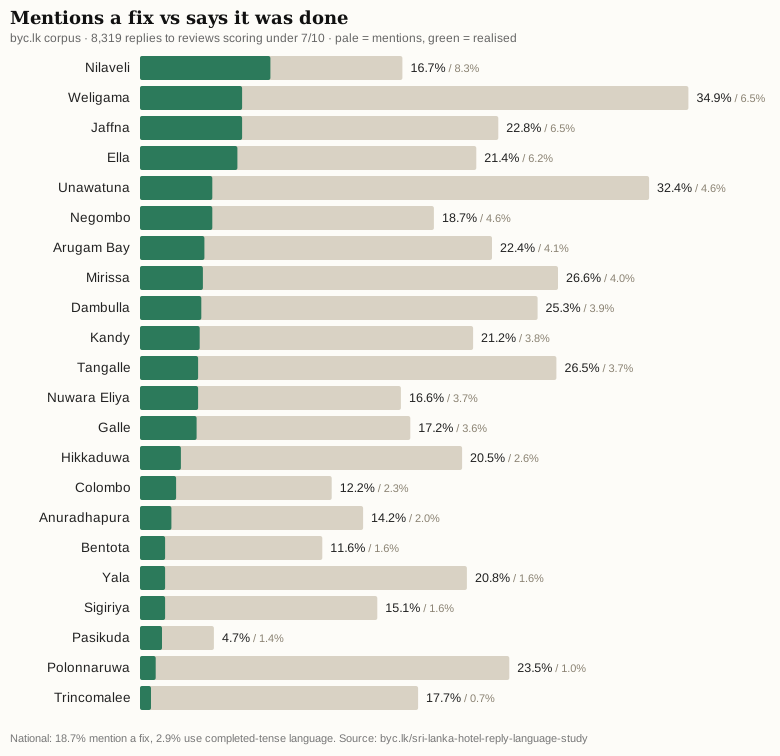
The pale bar is “mentions a fix”. The green bar is “says it was done”. Read the gap between them:
- Nilaveli 16.7% / 8.3% (n=120) · Jaffna 22.8% / 6.5% (92) · Weligama 34.9% / 6.5% (169) · Ella 21.4% / 6.2% (435)
- Unawatuna 32.4% / 4.6% (216) · Negombo 18.7% / 4.6% (675) · Arugam Bay 22.4% / 4.1% (245) · Mirissa 26.6% / 4.0% (346)
- Dambulla 25.3% / 3.9% (154) · Kandy 21.2% / 3.8% (520) · Tangalle 26.5% / 3.7% (189) · Nuwara Eliya 16.6% / 3.7% (379)
- Galle 17.2% / 3.6% (274) · Hikkaduwa 20.5% / 2.6% (195) · Colombo 12.2% / 2.3% (1,155) · Anuradhapura 14.2% / 2.0% (344)
- Bentota 11.6% / 1.6% (371) · Yala 20.8% / 1.6% (438) · Sigiriya 15.1% / 1.6% (377) · Pasikuda 4.7% / 1.4% (148)
- Polonnaruwa 23.5% / 1.0% (98) · Trincomalee 17.7% / 0.7% (299)
Two things stand out. First, the two bars are not proportional: Weligama mentions fixes more than seven times as often as Trincomalee (34.9% vs 4.7%) but says a fix was done nine times as often (6.5% vs 0.7%) — the ratio between the instruments varies wildly by region, which means the wide measure is measuring style, not process. Second, the regions at the top of the wide measure are the ones with the smallest samples: Nilaveli at 120 replies and Jaffna at 92. The completed-tense measure is built from far fewer events per region, so treat the ordering as a range, not a league table.
The one robust statement is national, not regional: roughly one complaint reply in five names a fix, and one in 34 says it was done. Anywhere you stay, the second number is the one to look for.
4. The three sentences you will actually read
From the corpus, lightly trimmed, keeping the grammar intact:
- The objectless promise: “Your comments have been taken very seriously, and we will be addressing this matter with our housekeeping and maintenance teams to ensure immediate improvements.” No object, no date, no person. It appears, in near-identical form, thousands of times.
- The completed claim: “The bell was broken and we have now fixed it.” Nine words. One object, one tense, one implied time. You can ask when, and the answer is a date.
- The forward-dated fix: “The ancestral house has now been fully renovated with better ventilation and sealed walls, so the issue of dampness and humidity is no longer a concern.” Past tense, specific measures, a stated consequence. This is the strongest form in the corpus and it is rare.
There is a fourth shape worth naming, because it is the most honest thing in the data: “We tried to get it fixed, but we could not find the technician in the middle of the night.” It names the failure, the attempt and the obstacle. It scores zero on our fix-detection instrument for the same reason the promise does — no completed action — and it is worth more to a reader than either.
5. The honest limits
This is a linguistic audit, and language is a proxy. Three things it cannot do:
- It cannot tell whether the fix happened. A property can write “we have replaced it” about a mattress nobody touched. Completed-tense language correlates with having a work order to quote, not with the work being done — and no corpus of hotel replies can close that gap.
- The tense coding is a rule, not a reader. Rule-based sentence coding with an explicit conservative bias: ambiguity counts against the property. A human linguist would disagree with some individual tags, and the direction of that disagreement is deliberately set in one direction.
- The language of the data is English. Only 3.8% of reviews in this slice are written in a non-Latin script, and 98.2% of replies are English. Every reply in this study is a reply written for an English-speaking audience — the same hotel may say something very different in German, and we cannot see it.
6. How to use it before you book
- Ignore the opening. 68% of these replies start with your name and 57% end with a sign-off. Both are auto-inserted. Read the two sentences in the middle.
- Hunt for a past-tense fix. Ctrl-F the review page for “has been”, “we replaced”, “was fixed”, “since then”. If nothing comes back in a 700-character reply, the hotel is describing intentions.
- Prefer the reply that admits a failure. “We could not find the technician” is a real sentence about a real night. It tells you the hotel tried and lost, which is more useful than a promise that contains no information at all.
- Cross-read with the reply index. Our fix-the-artefact index ranks regions by whether replies name any fix at all; this page asks whether they claim it was done. Read together, they separate a hotel with a maintenance culture from a hotel with a good letter-writer.
- Then check the complaint itself. The word study shows which words actually travel with low scores. A named fix under a complaint about a genuine problem is the best signal the corpus offers.
7. Where this comes from
This is the third cut of the same 49,433 owner replies. What hotels say back measured the whole field: reply rates, duplication, dispute, and the fact that 31.4% of replies are copy-paste. The fix index asked where fix-naming concentrates and found a nine-fold regional spread. This page asks a narrower and, we think, more useful question: when a hotel says something was done, does it say it in the past tense?
The answer is that only about one reply in six of those that mention a fix frames it as finished. The rest are futures.
A different cut of the same words. The five-language study applies the same counting method to the reviews rather than the replies, and finds that German, French, Spanish, Italian and English guests gave almost identical scores while writing about almost entirely different things.
8. Method and limits
Sample. 291,887-review byc.lk corpus (10-point scale, Booking.com source). Owner replies to reviews scoring strictly below 7/10 with reply body ≥ 60 characters: 8,319. Replies naming a fix: 1,555 (18.7%). Replies with at least one completed-tense fix sentence: 243 (2.9%).
Fix instrument. Case-insensitive regex: \b(fix|fixed|fixing|repair|repaired|replace|replaced|replacing|replacement|maintenance|renovat|renew|upgrad).
Tense instrument. Sentence split on terminal punctuation and newlines; a sentence must match the completed-tense set (has been, have been, have already, already, now fixed/replaced/repaired/working/resolved, was fixed/replaced/..., were ..., is fixed/working, fixed it, replaced it, we fixed, we replaced, since your stay, after your departure, have resolved) and must not match the forward-looking set (will, shall, going to, to be, scheduled, upcoming, future, soon, currently, ongoing, in progress, being ..., looking into, investigating, addressing, reviewing, initiated, phase, ensure, prevent, plan). Unresolved cases are not counted as realised.
Other measures. English function-word presence for language detection (98.2% of replies contain at least two of the, and, was, were, we, your, thank, room, staff, stay); greeting-with-name regex for personalisation (68.0%); sign-off regex (warm regards, kind regards, best regards, sincerely, regards, the team, management team, looking forward to) for signatures (57.1%).
What is not claimed. No causal claim between reply language and guest satisfaction. No claim that any stated fix happened. No reply or stay timestamps exist in the corpus, so nothing here is a before/after. Regional figures rest on small samples at the top of the table and are reported as ranges.
Frequently asked questions
What percentage of Sri Lankan hotel replies to bad reviews name a fix?
18.7% - 1,555 of 8,319 replies written under reviews scoring below 7/10 name a repair, replacement, renewal, upgrade or maintenance action. Only 2.9% of the same replies say in the past tense that the fix was already done.
What does "we will ensure this does not happen again" mean in a hotel reply?
Nothing checkable. It contains no object, no date and no actor, so nobody can verify whether it happened. In the byc.lk corpus this vocabulary of intention makes up the bulk of the 57.1% of complaint replies that mention no concrete fix at all.
How can I tell if a hotel reply to a bad review is genuine?
Look for a completed-tense sentence with an actual object in it - "the bell was broken and we have now fixed it" - and prefer replies that name a specific failure, even one they could not fix. Ignore the greeting and the sign-off, which appear in 68% and 57% of replies respectively.
Do longer hotel replies mean better service?
No. The median complaint reply in the corpus is 729 characters against a 385-character review, and 70.8% of replies are longer than the complaint they answer. Length is the most consistently delivered thing in the data and the least informative.
Which Sri Lankan region has the most honest hotel replies?
By the share of complaint replies claiming a completed fix, Nilaveli (8.3%, n=120), Weligama and Jaffna (6.5% each) lead and Trincomalee (0.7%) trails. Samples at the top are small, so the reliable finding is the national rate of 2.9%, not the regional ordering.
10. The bottom line
Of 8,319 replies to bad Sri Lankan hotel reviews, 18.7% name something that was fixed and 2.9% say it has already been done. The gap between those two numbers is the gap between a hotel that has a maintenance process and a hotel that has a complaints process — and it is visible in a single verb tense.
When you read reviews this week, ignore the greeting, ignore the apology, and look for one sentence with a noun and an “ed” on the end. If it is not there, the reply is a letter, not a record.
Method: 8,319 owner replies to reviews scoring under 7/10 with a reply body over 60 characters, drawn from the 291,887-review byc.lk corpus. Fix mention 18.7% (1,555); completed-tense fix language 2.9% (243), coded conservatively so ambiguity counts against the property. No reply or stay timestamps exist in the data. Last updated: 26 October 2026.
Plan your Sri Lanka trip with BYC at byc.lk — Free and honest. Some links are affiliate links and never change our advice.
Have a specific question about your Sri Lanka trip?
Ask BYC at byc.lk — Free and honest. Some links are affiliate links and never change our advice.
Ask BYC Your Question →