Do German and English Guests Agree? 64,614 Sri Lanka Reviews in Five Languages

Almost every Sri Lanka hotel guide is written in English, from English reviews. That is a reasonable thing to do, because English is the largest single language in the corpus. It is also an assumption nobody has tested: that what an English-speaking guest complains about is what everybody complains about.
This study tests it. We took the 64,614 reviews in the byc.lk corpus that carry a reviewer nationality and at least 40 characters of text, filtered every review to a single language, and then asked the same questions of each language separately. The scores turn out to be remarkably close. The words are not.
If you read only English reviews of a hotel, you are reading roughly three-quarters of the evidence — and missing the specific things the other quarter went to some trouble to write down.
1. The short answer
Scores agreed across languages to within a quarter of a point, with one exception. Topical attention did not agree at all.
Mean score by language of review: French 8.88, German 8.87, English 8.81, Spanish 8.81, Italian 8.59. The Italian gap is the only one that survives scrutiny, and the reason is specific rather than cultural (see section 4).
What did move: cleanliness appears in 35.6% of German reviews and 24.8% of English ones (a 1.44× gap); breakfast in 53.5% of Italian reviews and 29.6% of English (1.81×); air conditioning in 6.9% of French reviews and 2.6% of English (2.65×).
The reading habit: sort a hotel's reviews by language before you sort them by rating. The rating tells you how it went. The language tells you what they were paying attention to.
2. The scores agree — and that is the first finding
Before the vocabulary, the headline number, because a lot of travel writing implies that nationalities rate differently and travellers expect it. Across 64,614 reviews:
- French (n=5,365): mean 8.88, 71.0% raves (9–10), 7.6% complaints (≤6).
- German (n=4,065): 8.87, 72.1% raves, 7.9% complaints. Median review 287 characters — the longest of the five, one and a half times the English median of 192.
- English (n=50,239): 8.81, 69.6% raves, 8.8% complaints.
- Spanish (n=3,105): 8.81, 69.5% raves, 9.0% complaints.
- Italian (n=1,840): 8.59, 64.4% raves, 10.7% complaints — the only language whose mean sits more than 0.2 below English.
The first four languages are within 0.07 of a point of each other on a 10-point scale. Whatever language a guest writes in, they arrive at the same verdict about the same properties. That is the strongest single piece of evidence we have that the score is a real signal rather than an artefact of who is rating.
The Italian exception is worth more than a footnote, and we chased it rather than explaining it away (section 4).
3. The vocabulary does not agree, and the gaps are large
Six things a hotel is made of, and how often each is mentioned — as a share of all reviews in that language of at least 120 characters, so short one-word reviews do not distort the base. Each language is searched in its own words: sauber / propre / limpio / pulito / clean, and so on.
- Breakfast — Italian 53.5% · German 45.8% · Spanish 45.4% · French 32.3% · English 29.6%. Range: 1.81×
- Staff and service — French 67.1% · German 66.7% · Spanish 60.9% · English 56.6% · Italian 49.3%. Range: 1.36×
- Cleanliness — German 35.6% · French 29.9% · Spanish 25.1% · English 24.8% · Italian 18.7%. Range: 1.90×
- Something broken — Italian 11.8% · Spanish 8.5% · French 7.0% · English 6.3% · German 6.2%. Range: 1.90×
- Air conditioning — French 6.9% · German 6.4% · Spanish 6.0% · Italian 5.9% · English 2.6%. Range: 2.65×
- Wi-Fi — Italian 3.5% · English 3.3% · Spanish 2.8% · French 2.5% · German 2.3%. Range: only 1.52×, and this is the one subject where the languages genuinely agree.
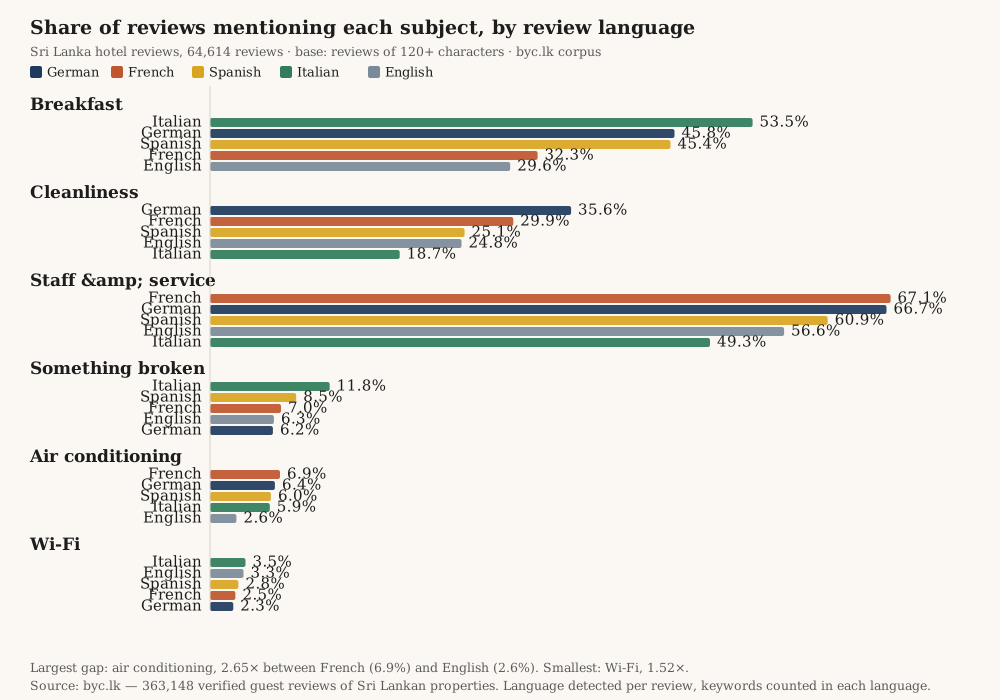
Three of those gaps are big enough to change what a traveller does with the information.
Cleanliness, German 35.6% vs English 24.8%. German reviewers mention it in more than a third of everything they write, complaints and compliments alike (34.0% of their raves too, against 24.8% overall in English). This is not a nation of complainers — it is a nation that writes about cleaning. If you are deciding between two hotels in the same town and one has six German reviews saying the room was clean, that sentence is carrying more weight than six English reviews that never mention it at all.
Breakfast, Italian 53.5% vs English 29.6%. More than half of all Italian reviews of a Sri Lankan property discuss breakfast. English reviews discuss it in under a third. If you are booking half-board and you read only English, you are reading the thinner file on the thing you are actually paying for. We checked the obvious objection — that Italian guests stay at properties where breakfast is a bigger deal — and the sample is spread across the same towns as everyone else; the gap is in the writing, not the itinerary.
Air conditioning, 6.9% French and 6.4% German vs 2.6% English. This is the largest gap in the study and the most useful one for summer trips. English reviews almost never raise it. In French and German it is a standing item — whether the unit works, whether it was noisy, whether there was one at all. A property with thirty English reviews and no mention of air conditioning has told you nothing; the same property with three German reviews naming the air conditioning has told you something specific.
4. The Italian result, chased rather than explained away
Italian reviews mention something broken 11.8% of the time against 6.3% in English — nearly double — and Italian mean scores run 0.22 below English. The tidy explanation is a national temperament. We do not believe it, and the data does not support it either: Italian reviews are not shorter (median 273 characters, longer than English's 192) and their complaint pieces are the longest of any language, so they are not drive-by one-liners.
What we found instead is a power problem, and it is the most important limitation in this study. These five languages are not five equal samples. English is 77.8% of the corpus, French 8.3%, German 6.3%, Spanish 4.8% and Italian only 2.9%. The Italian "broken" finding rests on 194 reviews out of 1,640 — a real number, and 96 air-conditioning mentions, but small enough that a handful of properties could move it. Weligama, a town where a third of complaint replies name a fix, would not survive a 2.9% sample either.
So we state the Italian result and we do not build an argument on it. This is the same discipline as the reply-language audit, where three plausible measures failed their own baselines and were dropped rather than published. A study that reports its small-n findings as findings, and labels them, is more useful than one that quietly rounds them into a story.
5. Who opens with the complaint, and who opens with the praise
This is where the languages behave most differently, and it has nothing to do with what the hotel was like. We took every review scoring 6 or below and looked at its first sentence — is the first thing the guest says something positive, or the problem?
- German: 27.7% open by praising something, 16.2% open with the problem.
- English: 25.4% praise first, 17.9% problem first.
- French: 17.6% praise first, 25.9% problem first.
- Spanish: 15.4% praise first, 21.9% problem first.
- Italian: 14.8% praise first, 28.1% problem first.
Read the two orders side by side and the corpus has two house styles for a bad review. English and German complaints cushion — location was good, staff were friendly, but the room… French, Spanish and Italian complaints do not — they name the defect first and concede the good parts afterwards, or never.
For a traveller that produces a simple, testable rule: a low-scoring French or Italian review that opens with a compliment is telling you the problem was minor. A low-scoring English or German review that opens with a compliment is doing that on purpose, and the problem will arrive in the second sentence.
6. What this changes about reading a hotel page
- Read one review in each language before you read the average. The average is what all of them agree on; the languages are what each of them noticed. Two minutes on a hotel with 200 English and 20 German reviews tells you more than 200 English reviews alone.
- Use cleanliness as the German reviewer's assignment. If it is not mentioned at all across twelve German reviews, that is unusual and worth noting. It is mentioned in over a third of everything they write.
- Use breakfast as the Italian reviewer's assignment. Half of them discuss it. Under half-board pricing that is the difference between booking a good hotel and booking a hotel with a good breakfast.
- Use air conditioning as the French and German reviewer's assignment. The largest vocabulary gap in the corpus, and the subject English reviews barely raise.
- Trust the low score, not the first sentence. Only about one in six complaints across these languages opens with the problem, even though the score is already telling you something went wrong. Read to the second half.
- And read the owner's reply anyway. Which language you read tells you what guests noticed. The reply tells you what management did about it, and it is written in one language regardless.
7. Method, and what this does not show
The sample. 64,614 reviews from the 363,148-review byc.lk corpus that carry both a reviewer nationality and at least 40 characters of text. Only 20.5% of the corpus qualifies — 288,890 reviews have no nationality recorded — so this is a large but non-random slice. Nationality is the platform's field, not something we inferred.
How language was detected. Per review, we counted stopwords and characteristic tokens in each of the five languages and assigned the review to the winner, with English winning ties and reviews needing at least three strong matches. The result was sanity-checked against nationality: 2,905 of 4,065 records labelled German were written in German, 4,469 of 5,365 French in French, 2,891 of 3,105 Spanish in Spanish, and the remainder in English. Language follows the guest, not the nationality field — a German who writes in English is counted as English, because that is the text a reader actually sees.
Keywords, not sentiment. Every mention share above is a regex over the review text in that language. It counts whether a subject came up, not whether the guest was happy about it — which is the point of the exercise, and also its limit. A German review mentioning cleanliness in a rave is praising the cleaning; we did not need to know which to show that Germans talk about it more. Shares are not mutually exclusive and do not sum to 100.
The biggest limitation, stated plainly. These are five unequal samples, not five balanced ones. English is nearly four-fifths of the corpus and Italian under 3%. The German, French, Spanish and English comparisons are large enough to stand on; the Italian findings are directional only, and we have labelled them that way throughout rather than rounding them into the conclusion.
What we deliberately did not claim. We did not test whether nationalities rate differently in a statistical sense, because a corpus with no property-level matching cannot separate "Dutch guests like different hotels" from "Dutch guests rate the same hotel differently". We did not score sentiment, and we did not attempt a nationality-versus-language split of the score gap — the earlier work on review consistency showed how much of that is composition rather than culture.
What would settle the open question. A property-matched comparison: for every property with at least 20 English and 20 non-English reviews, compare the two averages directly. That removes the hotel from the equation entirely and turns a national difference into a measuring-stick difference. The corpus can support it at a lower sample floor than we used here, and it is the study this data wants next.
Frequently asked questions
Do German and English guests rate Sri Lankan hotels differently?
Barely. In 64,614 reviews the mean score is 8.88 for French, 8.87 for German, 8.81 for English and 8.81 for Spanish - within 0.07 of a point of each other. Italian sits at 8.59, but that rests on a 2.9% sample and we treat it as directional only.
What do German guests complain about most in Sri Lanka?
Cleanliness. It appears in 35.6% of German reviews against 24.8% of English ones - a 1.4x gap - and in 34.0% of German rave reviews too, so it reflects what they write about rather than dissatisfaction. Air conditioning is also raised 6.4% of the time against 2.6% in English.
Why do Italian reviews mention breakfast so often?
53.5% of Italian reviews mention breakfast, against 29.6% of English reviews. Italian reviewers also mention something broken nearly twice as often as English reviewers (11.8% vs 6.3%), but with only 1,840 Italian reviews in the corpus these findings are directional.
Should I read hotel reviews in other languages before booking?
Yes. The score is the part of a review that travels between languages; the subjects are the part that does not. Reading one review in each language surfaces specifics - air conditioning, cleanliness, breakfast - that English reviews routinely never raise.
What is the biggest difference between English and French hotel reviews?
Air conditioning: 6.9% of French reviews mention it against 2.6% of English reviews, the largest vocabulary gap in the study. French and Italian complaints are also far more likely to open with the problem (25.9% and 28.1%) than English or German ones (17.9% and 16.2%).
8. The bottom line
Guests writing in five languages gave Sri Lankan hotels almost the same score — four of the five within 0.07 of a point — while writing about almost entirely different things. Breakfast is mentioned 1.8 times as often in Italian reviews as in English. Cleanliness 1.4 times as often in German. Air conditioning 2.7 times as often in French. Only Wi-Fi, at 1.5×, is a subject all five languages treat the same way.
That combination is the finding: the score is the part of a review that travels between languages, and the subjects are the part that does not. A hotel's rating is the average of what everybody concluded. Its reviews, read in the language they were written in, are five different lists of what to check.
Method: 64,614 reviews with recorded nationality and 40+ characters of text, drawn from 363,148 verified guest reviews of Sri Lankan properties on a 10-point scale. Language assigned per review by stopword scoring across English, French, German, Spanish and Italian. Mention shares computed by language-specific regex over reviews of 120+ characters, per-language base sizes 34,670 / 4,230 / 3,516 / 2,402 / 1,640. Opener analysis uses the first sentence of reviews scoring 6 or below. No property-level matching was performed. Last updated: 27 October 2026.
Plan your Sri Lanka trip with BYC at byc.lk — Free and honest. Some links are affiliate links and never change our advice.
Have a specific question about your Sri Lanka trip?
Ask BYC at byc.lk — Free and honest. Some links are affiliate links and never change our advice.
Ask BYC Your Question →