Sri Lanka Hotel Review Risk by Region: Which Destinations Get the Bad Reviews
You are choosing where to sleep in Sri Lanka, and every destination you are considering averages somewhere between 8.5 and 9.2 out of 10. Sigiriya averages 9.04. Colombo averages 8.24. Mirissa 8.56, Ella 8.81, Galle 8.70. Those numbers are so close together that they carry almost no information: the gap between the best and worst destination on average score is smaller than the gap between two properties in the same town. So a traveller comparing destinations by average rating is comparing noise.
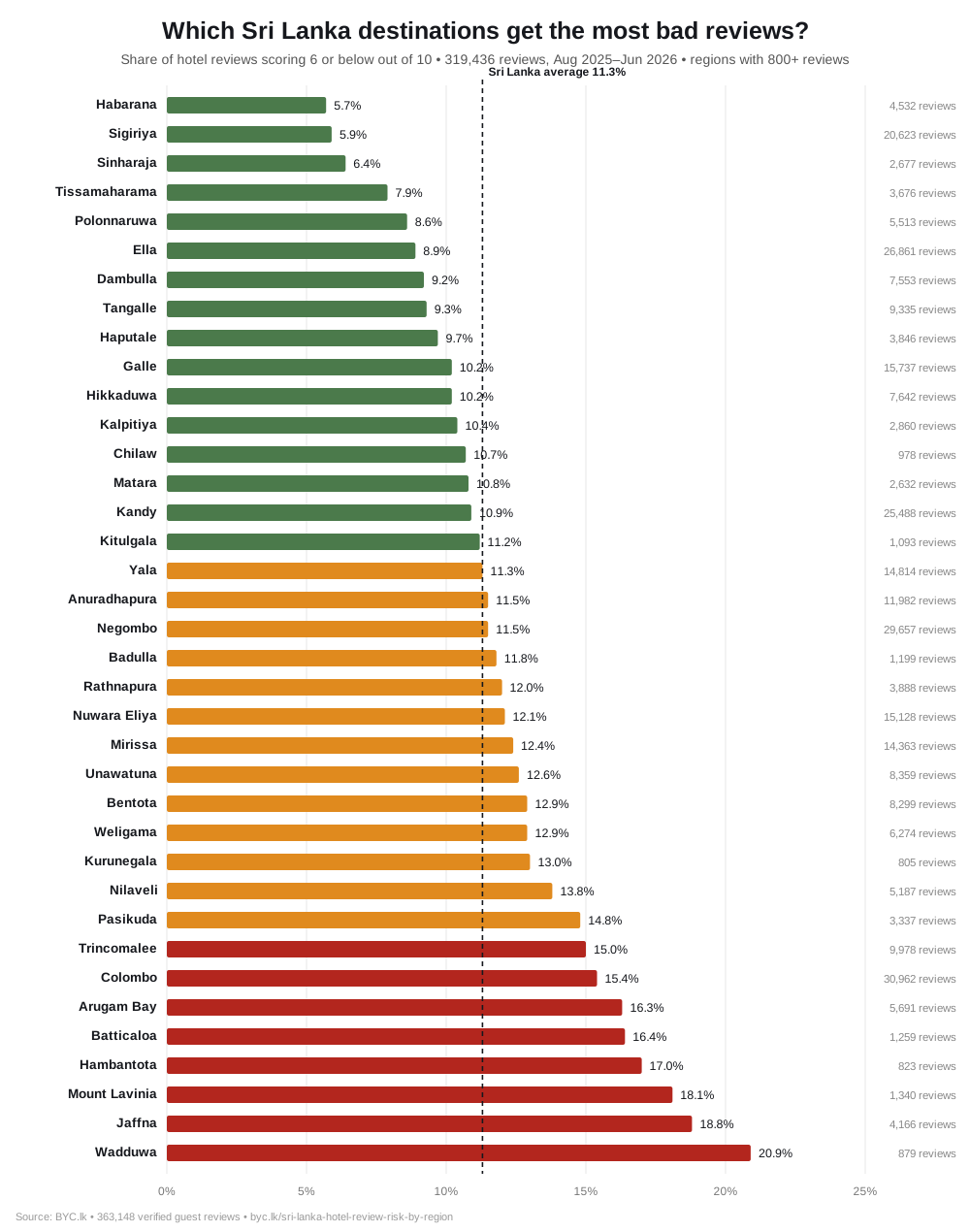
This tool replaces the average with the number that actually decides a trip: how often it goes wrong. For 37 Sri Lankan destinations with at least 800 recent reviews — 319,436 reviews in total — we counted the share that score 6 or below out of 10. That is the tail, not the average. It is the review written by somebody whose trip had a bad night in it.
It ranges from 5.7% in Habarana to 20.9% in Wadduwa. That is a 3.7× spread in how often guests have a bad stay, in destinations whose average scores are two-tenths of a point apart.
1. The short answer
Risk is not evenly spread, and it is not where the average score suggests. The lowest bad-review shares in the country are in the inland and southern cultural areas — Habarana 5.7%, Sigiriya 5.9%, Sinharaja 6.4%, Tissamaharama 7.9% — against a national figure of 11.3%. The highest are on the northern and eastern edges, in the capital, and in a handful of coastal suburbs: Wadduwa 20.9%, Jaffna 18.8%, Mount Lavinia 18.1%, Jaffna 18.8%.
Eight destinations sit at or above 15%. In the worst of them, roughly one review in five is written by a guest who had a genuinely bad stay — against roughly one in seventeen in Sigiriya.
What to do with it: risk is a tax you can budget for. In a high-share destination, do not compare properties by average score; read the recent one- and two-star reviews and look for repeats. In a low-share destination, the average is trustworthy enough to book from. Both are on this page.
The honest caveat, stated first: a bad-review share is not a measure of hotel quality. It is a measure of variance — how much difference there is between one property and the next, and between one night and the next, in the same town. High variance is genuinely useful information before you book. It just is not the same thing as "worse hotels".
2. The full table: bad-review share, all 37 destinations
Reviews scoring 6 or below, as a share of all reviews for that destination from August 2025 to June 2026. National figure across the same window: 11.3%. Sample sizes are shown because a destination with 800 reviews is a smaller instrument than one with 30,000.
The lowest-risk destinations (green on the chart, at or below the national figure):
- Habarana — 5.7% of 4,532 reviews score 6 or below (average score 9.16)
- Sigiriya — 5.9% of 20,623 reviews score 6 or below (average score 9.04)
- Sinharaja — 6.4% of 2,677 reviews score 6 or below (average score 9.14)
- Tissamaharama — 7.9% of 3,676 reviews score 6 or below (average score 9.01)
- Polonnaruwa — 8.6% of 5,513 reviews (average 8.86)
- Ella — 8.9% of 26,861 reviews (average 8.81) — the highest-risk of the very low group, and the largest sample in it
- Dambulla — 9.2% (7,553) · Tangalle 9.3% (9,335) · Haputale 9.7% (3,846)
- Galle 10.2% (15,737) · Hikkaduwa 10.2% (7,642) · Kalpitiya 10.4% (2,860) · Matara 10.8% (2,632) · Kandy 10.9% (25,488)
The highest-risk destinations (red on the chart, at or above 15%):
- Wadduwa — 20.9% of 879 reviews score 6 or below (average score 8.04)
- Jaffna — 18.8% of 4,166 reviews score 6 or below (average score 8.04)
- Mount Lavinia — 18.1% of 1,340 reviews score 6 or below (average score 8.11)
- Hambantota — 17.0% of 823 reviews score 6 or below (average score 8.29)
- Batticaloa — 16.4% of 1,259 reviews score 6 or below (average score 8.32)
- Arugam Bay — 16.3% of 5,691 reviews score 6 or below (average score 8.35)
- Colombo — 15.4% of 30,962 reviews score 6 or below (average score 8.24)
- Trincomalee — 15.0% of 9,978 reviews score 6 or below (average score 8.3)
Between those two ends, the middle of the table is unremarkable and that is the point: Mirissa 12.4%, Weligama 12.9%, Bentota 12.9%, Unawatuna 12.6%, Nuwara Eliya 12.1% — the famous beach destinations all sit modestly above the national figure, not far from it. Nobody needs to avoid them. They simply do not carry the reliability the cultural triangle does.
3. How to use this before you book
This is the part that turns a table into a decision. The share tells you which reading strategy to use once you are on a booking page.
- In a low-risk destination (under ~9%), book from the average. In Sigiriya or Habarana a 9.0 property is probably a 9.0 property, because only about one review in seventeen is a bad one. The average is doing its job.
- In a high-risk destination (over ~15%), read the tail first. In Wadduwa or Jaffna, one review in five is a bad one, so the average is being pulled in two directions by a large minority. Sort by lowest score, read the two most recent, and look for repeats — the same complaint from two different guests is a fact about the property; one is an event.
- Pay attention to sample size. Wadduwa's 20.9% rests on 879 reviews; Jaffna's 18.8% on 4,166. Both are large enough to be real, but Wadduwa is a small town with a small hotel stock — a single badly-run large property moves that number more than it would in Colombo.
- Do not read this as a reason to skip the east or the north. Jaffna and Batticaloa are two of the most interesting places in the country, and their numbers are partly a consequence of thin, older hotel stock and a much shorter high season. Go — and book the newest property you can afford rather than the cheapest.
- Cross-read the reply field. A high bad-review share in a city with a low fix-naming rate is the worst combination in the corpus. Our regional fix index measures exactly that, and Colombo is low on both.
- Then check the score itself. A destination average of 8.8 is built from a bimodal distribution, not a bell curve — see why a 9.0 can still be a bad stay for how the 10-point scale is actually shaped.
4. Why the averages hide this
Sri Lankan guest reviews are not normally distributed. Across the whole corpus, roughly 69% of reviews score 9 or 10, about 19% score 7–8, and 11% score 6 or below. Two destinations with very different tails can produce almost the same mean, because the tail is a small share of the arithmetic and a large share of the experience.
Wadduwa averages 8.04 and Colombo averages 8.24 — three-hundredths of a point apart on a ten-point scale, which is nothing. But Wadduwa's bad-review share is 20.9% against Colombo's 15.4%. And when you go the other way: Habarana (5.7%) and Sigiriya (5.9%) average 9.16 and 9.04 — a difference a traveller would call "identical". Their shared quality is not that they are better, it is that they are consistent.
That gives a cleaner way to say the whole study: the average score measures how good the good nights are. The bad-review share measures how often a bad night happens. Both matter. Only one of them is being shown to you on a booking site.
5. What this cannot tell you
Three limits, and they are real:
- It is not a quality ranking. A destination can have a high bad-review share because it has one large, poorly-run property with hundreds of reviews, or because its hotel stock is old, or because it is a one-night transit stop where people are tired. Wadduwa is mostly the first: it is a small Colombo-adjacent beach suburb with a thin, older hotel base. The number is a fact about the distribution, not a verdict on the town.
- Seasonality is not removed. This window spans a full year, but destinations with concentrated seasons have their share diluted by months when nobody is reviewing. A destination that only operates four months a year is being measured mostly on those four months.
- It is cross-sectional. Nothing here says a destination is getting better or worse. We can see the snapshot, not the trend.
Method in one paragraph. The byc.lk corpus holds 363,148 verified guest reviews of Sri Lankan properties, collected from Booking.com and scored on a 10-point scale. This page takes the 319,436 reviews dated 1 August 2025 to 30 June 2026 whose destination resolves to one of the 37 regions with at least 800 reviews in that window, and counts those scoring 6 or below. Scores come from the platform, not from us. Destinations under 800 reviews are excluded rather than shown with a caveat, because at that size the number moves too much to be worth publishing. Regions are assigned from the property's location.
6. What this changes about planning
Two practical consequences, one for the itinerary and one for the booking page.
For the itinerary: the cultural triangle — Habarana, Sigiriya, Polonnaruwa, Dambulla — is the most reliable hotel region in the country, and it now has a number attached: 5.7%, 5.9%, 8.6% and 9.2%. If you are building a trip and want the nights that cannot go wrong, put more of your nights there and fewer in the transit suburbs. This is the opposite of most itineraries, which treat the cultural triangle as two rushed days.
For the booking page: in a high-risk destination, budget ten minutes to read reviews in ascending score order before you book anything, and use the pattern in our review-language study to tell a real complaint from a mismatched guest. In a low-risk destination, you can skip that and spend the ten minutes on the score distribution instead.
The point of the whole exercise is that a national average of 8.6 is not a promise about your holiday. It is the middle of a distribution. Where you sleep decides which part of that distribution you land in.
7. WATCH OUT FOR
- Comparing destinations by average score. The spread of averages is smaller than the spread within a single town. It is the single most common planning error in Sri Lankan hotel research, and this page exists to correct it.
- One large property dragging a small town. Wadduwa's 879 reviews across a small hotel stock means a single property can move the town's number several points. Read the number as "this town has a wide spread", not "this town's hotels are bad".
- Treating a high share as a reason to cancel the region. The east and the north are two of the best-value and least-crowded parts of the country. Their review numbers partly reflect thin hotel stock and short seasons at least as much as they reflect service.
- Assuming a low share means a low price. Sigiriya and Habarana have the best reliability in the country and sit in the middle of the price range, not the bottom. Reliability is not correlated with cheapness here.
- Reading the table as a trend. This is one window, not a history. A destination that opened six large hotels last year has not had time to show up in its own numbers.
8. GOOD TO KNOW
- The national figure is 11.3% across the same window — so any destination below that is more reliable than the country as a whole, and any above is less.
- The biggest surprise is Ella. It carries the largest sample in the low group (26,861 reviews) at 8.9%, despite being the destination travellers most often describe as over-touristed. The crowds are real; the hotel risk is not.
- The second biggest is Jaffna at 18.8% from 4,166 reviews — nearly one in five. If you are going north, this is the number to plan around, and the fix is booking newer properties.
- Colombo at 15.4% from 30,962 reviews is the most statistically solid finding on the page, and it is not about one hotel: it is about a city stock that mixes airport-transit rooms, business hotels and a very wide range of price points.
- Sample floors matter. 800 reviews is the floor for this table. Around 35% of the corpus's destinations sit below it and are excluded — a smaller town with 300 reviews can swing five points on one bad weekend.
- The chart is free to reuse. It is a single SVG with no third-party imagery: region-risk-1027.svg. Cite as "BYC.lk, 319,436 guest reviews, October 2026".
9. WHERE TO STAY
The question this table answers is not "which town", it is "how much do I need to check". So these are the two ends of the distribution, and what a booking looks like at each.
- If you want the lowest-risk nights in the country: Habarana and Sigiriya, at 5.7% and 5.9%. Book from the average; a 9.0 here is what it says it is. This is also where the largest concentration of high-scoring safari lodges and small guesthouses in the corpus sits. See our Sigiriya guide and Habarana.
- If you are going to a high-risk destination anyway — and you should: Wadduwa, Jaffna, Mount Lavinia, Batticaloa, Arugam Bay, Hambantota, Colombo and Trincomalee are all above 15%. Book the newest property you can afford, read the two most recent lowest-score reviews, and ignore every review older than eighteen months.
- If you are choosing between coast and interior: the interior wins on reliability, and the coast wins on everything else. That trade-off is the honest summary of this dataset, and the month you travel changes both sides of it.
Plan your Sri Lanka trip with BYC at byc.lk — Free and honest. Some links are affiliate links and never change our advice.
Have a specific question about your Sri Lanka trip?
Ask BYC at byc.lk — Free and honest. Some links are affiliate links and never change our advice.
Ask BYC Your Question →