What a Sri Lankan Hotel Room Is Really Like When You Travel Alone: 1,891 Reviews
There is a specific room in every Sri Lankan hotel that nobody writes good things about, and it is usually the one given to the guest who arrived alone. It is cheap, it is not advertised, and in our corpus it has no name at all: of the 17,402 reviews that Booking.com tags as written by solo travellers, not one is attached to a single room. They are all Deluxe Double Rooms, Standard Doubles, Deluxe Doubles with Balcony. The solo guest is put in a double room and the double room is what gets reviewed — which is exactly why the complaints that follow read the way they do.
So we asked the corpus the blunt version of the question: what is a Sri Lankan hotel room actually like when only one person is staying in it? Because the data has no single/double booking field, the population is the reviews whose own words say it — solo, on my own, by myself, travelling alone, a single room — minus any review that also mentions a partner, children, family or friends. That leaves 1,891 reviews out of 218,993 with usable text, and the gap between them and everything else is the finding.
The short answer: the room itself is usually the same room everybody else gets. What changes is who is on site when it goes wrong. In the 1,891 reviews written by guests staying alone, the average is 7.49/10 against 8.74 for the corpus, and 27.8% score 6 or below against 10.3%. That is a real and large gap — but read the failure themes and it is not a story about mattress quality. Feeling unsafe appears in 8.7% of the low-scoring solo reviews against 0.3% of the corpus — 13.3×. No staff, or nobody at reception is 12.0× the corpus rate. Being the only guest is 6.0×. And “no staff at reception” appears in zero of the 1,130 solo reviews that score 9 or above.
1. The short answer, in one paragraph
A guest alone does not get a worse room in Sri Lanka. They get the same room with less of everything around it — fewer staff on site, fewer other guests to notice a problem, and no second person to call reception while the other one waits with the bags. When the property is run and staffed, the solo stay scores like any other (59.8% of these reviews score 9 or above). When it is a villa or guesthouse with nobody on the gate, the same room becomes a 16.2-point experience: 16.2% of solo reviews score 2 or below, against 3.6% overall.
The practical consequence: the single most useful thing you can check before booking a cheap room as one person is not the room. It is whether there is a person there when you arrive, and through the night. Reviews answer that question, in plain words, far more often than listings do.
2. Why the corpus’s own data can’t see this — and what we did instead
The honest method note matters more here than usual, because the population is a proxy. The review data we hold has a room-type field, and it is useless for this question: the 17,402 reviews tagged as solo travellers are attached to doubles and deluxe doubles, because that is what the properties sell. There is no “booked a single” flag, no party size, and no room price.
So the population is defined by the reviewer’s own description. A review is counted as a solo stay if its text contains one of: solo, on my own, by myself, I was alone, travelling alone, traveling alone, travelled alone, traveled alone, single room, as a single. It is excluded if the same text also mentions a wife, husband, partner, kids, children, son, daughter, family, baby, parents or friends — which removes the reviews that say “I was alone on the beach” in the middle of a family holiday. That is 1,891 reviews from 218,993 with usable text.
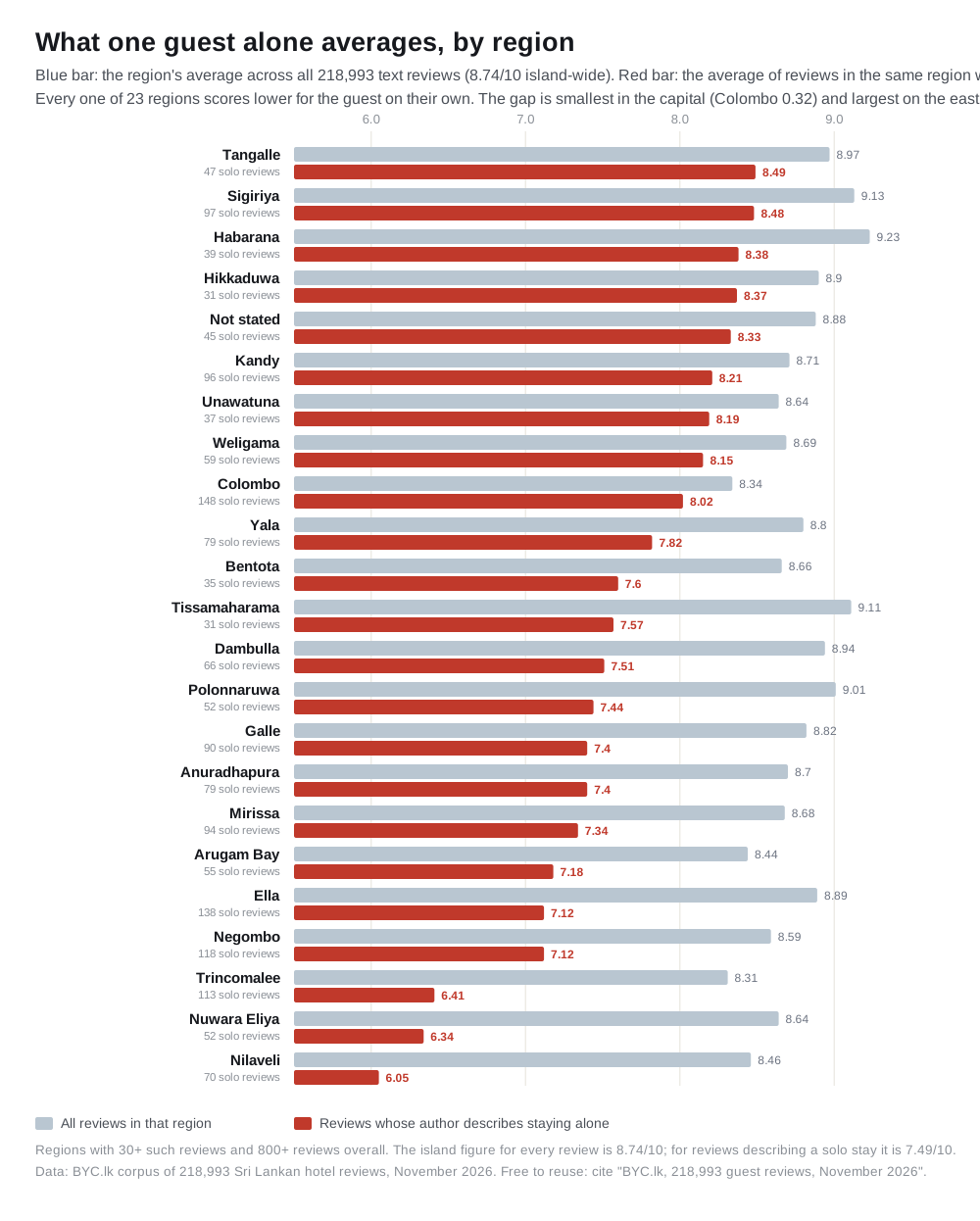
Two checks that the population is real. First, it is longer: the median solo review is 543 characters against 211 for the corpus. People writing about a stay on their own write three times as much, which is what you would expect if the stay was eventful. Second, and this predicts the whole study, the gap is not uniform: it is 0.32 of a point in Colombo and 2.41 points in Nilaveli (table in section 4). A sampling artefact would not have a geography.
3. What actually goes wrong: the failure themes, ranked
We searched the 526 solo reviews scoring 6 or below for thirteen themes, then did the same search across all 218,993 text reviews to get a baseline. The column that matters is the last one: how much more often the theme appears in a bad solo review than in a random review. A theme that is merely common (“staff”, 36% of all reviews) proves nothing. A theme that is rare everywhere else and common here is the signal.
| Theme | All reviews | Low-scoring solo reviews | High-scoring solo reviews | Lift |
|---|---|---|---|---|
| no staff, or nobody at reception | 0.1% | 4.4% | 0.0% | 44.0× |
| feeling unsafe | 0.4% | 8.7% | 2.5% | 21.7× |
| insects or animals in the room | 1.4% | 21.7% | 4.1% | 15.5× |
| cleanliness or smell | 2.7% | 32.5% | 4.8% | 12.0× |
| broken or missing air conditioning | 1.7% | 19.4% | 7.8% | 11.4× |
| hotel wifi | 2.7% | 30.6% | 9.0% | 11.3× |
| being the only guest, or feeling it | 0.1% | 1.0% | 0.4% | 10.0× |
| noise | 2.6% | 24.3% | 6.5% | 9.3× |
| price or value | 3.4% | 25.9% | 8.6% | 7.6× |
| hot water or the shower | 4.5% | 32.3% | 10.9% | 7.2× |
| tuk-tuk and transport | 6.9% | 29.3% | 19.2% | 4.2× |
| staff or host | 36.4% | 57.8% | 46.5% | 1.6× |
| breakfast or food | 32.3% | 47.7% | 34.9% | 1.5× |
Read the top rows. Insects, cleanliness, wifi, air conditioning and noise all behave the way you would expect — they are the vocabulary of a bad room, and they appear in bad reviews of every kind. The top two rows are different in kind. “No staff or nobody at reception” is in 0.1% of the whole corpus, 4.4% of bad solo reviews, and 0.0% of the good ones. “Feeling unsafe” is 0.3% of the corpus and 8.7% of bad solo reviews. These are not hotel-quality phrases. They are phrases about being a single person on an unattended property, and they split the solo population cleanly in two.
This is the part worth being careful about. We first ran this with a looser word list — uncomfortable, only guest, no one, unsafe — and the top theme came out looking like price. Reading twelve random matches showed why: “uncomfortable” appears in the middle of mattress, shower and smell complaints, and “no one” appears in sentences like “no one told us”. The numbers below are from the tight phrase set only, where the words mean what the theme says.
The single most quoted phrase in a bad solo review is not about comfort. It is a version of “nobody was there”. “Not safe because no one was on gate and no reception staff. No one was at the property, even no staff.” — 1/10, Negombo. “When I arrived there was no staff at all in sight and I wandered around for about 10 minutes until I found the staff area.” — 1/10. “There was no staff to talk to and when I tried to send them a message they did not respond.” — 1/10.
4. The region table: where the solo stay goes wrong, and where it doesn’t
Average review score, per region: all reviews in that region, then only the reviews whose author describes staying alone, and the difference. Only regions with 30+ solo reviews and 800+ reviews overall are shown — 23 of them.
| Region | Solo reviews | Solo average | All reviews | Gap | Solo scoring 6 or below | All scoring 6 or below |
|---|---|---|---|---|---|---|
| Nilaveli | 70 | 6.05 | 8.46 | 2.41 | 48.6% | 13.3% |
| Nuwara Eliya | 52 | 6.34 | 8.64 | 2.30 | 40.4% | 11.7% |
| Trincomalee | 113 | 6.41 | 8.31 | 1.90 | 42.5% | 15.3% |
| Ella | 138 | 7.12 | 8.89 | 1.77 | 27.5% | 8.2% |
| Polonnaruwa | 52 | 7.44 | 9.01 | 1.57 | 26.9% | 7.5% |
| Tissamaharama | 31 | 7.57 | 9.11 | 1.54 | 29.0% | 7.1% |
| Negombo | 118 | 7.12 | 8.59 | 1.47 | 32.2% | 10.3% |
| Dambulla | 66 | 7.51 | 8.94 | 1.43 | 25.8% | 8.9% |
| Galle | 90 | 7.4 | 8.82 | 1.42 | 25.6% | 9.1% |
| Mirissa | 94 | 7.34 | 8.68 | 1.34 | 30.9% | 11.5% |
| Anuradhapura | 79 | 7.4 | 8.7 | 1.30 | 29.1% | 9.9% |
| Arugam Bay | 55 | 7.18 | 8.44 | 1.26 | 34.5% | 15.5% |
| Bentota | 35 | 7.6 | 8.66 | 1.06 | 28.6% | 12.3% |
| Yala | 79 | 7.82 | 8.8 | 0.98 | 24.1% | 10.1% |
| Habarana | 39 | 8.38 | 9.23 | 0.85 | 20.5% | 5.1% |
| Sigiriya | 97 | 8.48 | 9.13 | 0.65 | 15.5% | 5.3% |
| Not stated | 45 | 8.33 | 8.88 | 0.55 | 17.8% | 8.6% |
| Weligama | 59 | 8.15 | 8.69 | 0.54 | 18.6% | 12.2% |
| Hikkaduwa | 31 | 8.37 | 8.9 | 0.53 | 19.4% | 10.0% |
| Kandy | 96 | 8.21 | 8.71 | 0.50 | 18.8% | 9.4% |
| Tangalle | 47 | 8.49 | 8.97 | 0.48 | 12.8% | 8.3% |
| Unawatuna | 37 | 8.19 | 8.64 | 0.45 | 21.6% | 12.6% |
| Colombo | 148 | 8.02 | 8.34 | 0.32 | 23.0% | 14.1% |
Three things are visible in that table and only one of them is obvious.
- Colombo is the safest place in the country to stay alone. 8.02/10 across 148 solo reviews against 8.34 for everyone — a gap of 0.32, the smallest on the table. An unattended villa barely exists in the capital, the hotels are staffed around the clock, and a guest on their own is unremarkable in a business hotel. This is the strongest single result in the study and it inverts what the island-wide reputation of Colombo would suggest.
- The east coast and the hills are where it goes wrong. Nilaveli 6.05/10 across 70 solo reviews against 8.46 for all reviews (2.41 points, and 48.6% of them scoring 6 or below against 13.3% for the region overall). Nuwara Eliya 6.34 against 8.64. Trincomalee 6.41 against 8.31 with 42.5% scoring 6 or below. These are exactly the places where the stock is small guesthouses and seasonal beach properties with one or two staff — and where a guest alone is more likely to be the only person in the building.
- Ella is the most interesting row. It averages 8.89 for all reviews and 7.12 for the 138 written by guests alone — a 1.77-point drop, on the largest solo sample after Colombo. Ella’s stock is view-chalets and hillside guesthouses with a steep walk, a shared terrace, and often a single host family. Beautiful and fine with company; quieter and less forgiving alone.
The two rows that would get a solo traveller into trouble if read as a recommendation: Tangalle (8.49 solo, 8.97 overall) and Sigiriya (8.48 solo, 9.13 overall). High averages and small gaps, in places where the rooms are spread out and the guests are mostly couples — the solo reviews here are the best in the country after Colombo, so if you want the beach alone and the rock alone, these are the two to book.
5. What to do about it, specifically
None of this means avoiding the cheap room as one person. It means checking three things that the reviews answer and the listing does not.
- Check for a night desk, not a reception. Search the property’s recent reviews for nobody, front desk, after 10, no one. The failure is rarely “no reception” — it is a reception that closes at 9pm on a property whose gate is open. In the solo reviews we read, a locked gate and a desk that closes early appeared together.
- Ask who else is staying. In the off and shoulder seasons, a 6-room guesthouse in Trincomalee or Nilaveli can be empty, and “being the only guest” appears 6.0× more often in solo reviews than in the corpus. Empty is not unsafe by itself, but an empty property is an unattended property. Reviews written in your month, rather than in February, tell you what it is like then.
- Prefer a staffed building for the first night. 59.8% of solo reviews score 9 or above — this is overwhelmingly a normal, good experience. The pattern in the bad ones is arrival. Book the staffed, larger property for night one, wherever you land, then move. It is also the cheapest mistake-proofing in the country: see getting in from the airport before you decide where night one is.
- Take the walk-in rate, not the cheapest room. Our regional risk study found the same structural thing from a different angle — see which destinations get the bad reviews, where Wadduwa runs 20.9% and Habarana 5.7% of reviews scoring 6 or below. A solo stay is that risk with nobody to share the problem with.
- Read the risk, then read the reply. A property that answers a bad review by naming what it fixed is the one that will answer you at 11pm: the fix index by region ranks that habit from 3.6% in Pasikuda to 32.7% in Weligama.
6. The broader solo picture
Two things this study deliberately does not claim. It does not measure safety on the street — that is a different corpus question, and the site already answers it in whether Sri Lanka is safe for women travelling and solo travel safety. What is measured here is the property: the room, the gate, the desk. It does not claim solo guests are treated worse on purpose. The score gap is consistent with a much simpler explanation, and we think it is the right one: a solo guest is one person absorbing every problem a property has, with no second opinion, no one to wait with the bags, and nobody to send to reception.
If you are building the trip rather than the hotel: one week solo for around $700 is the itinerary we keep recommending, couples vs solo vs families covers how the same island differs by who is with you, and what a private driver actually costs is the one booking where being alone changes the price rather than the experience.
7. Method and limits
Sample. 218,993 reviews in the BYC.lk corpus with 60+ characters of review text on a 10-point scale. Solo population: 1,891 reviews matching the solo phrase list and not matching the family/partner exclusion list. Region table restricted to 30+ solo reviews and 800+ overall reviews (23 regions).
Themes. Case-insensitive regex over the review text, phrase lists fixed before the final run (see section 3 for the failed looser version). Corpus baseline is the share of all 218,993 reviews matching the same list. Lift = share in low-scoring solo reviews ÷ share in the corpus.
The four limits that matter. (1) Self-selection. People who had a bad stay write about it at length — that is why the median solo review is 543 characters against 211 — so this population over-represents eventful stays. The 7.49 average is therefore a floor, not a measure of the typical solo stay: 59.8% of these reviews scored 9 or above. (2) The proxy is words, not bookings. Someone who stayed alone without saying so is missed, and someone who says “solo” while travelling with a friend in another room is counted. (3) Region samples are small. Nilaveli rests on 70 reviews and Nuwara Eliya on 52: enough to see the shape, not enough to rank two places three-tenths of a point apart. (4) No price field. We cannot say whether the solo rooms reviewed here were cheap ones, so the “cheap room” framing is a reasonable reading of a room-type field that has no single rooms in it, not a measured effect.
Frequently asked questions
Is it easy to stay alone in a Sri Lankan hotel?
Yes. 59.8% of the 1,891 reviews written by guests staying alone score 9 or above. The problems cluster in a minority of stays, and they are about unattended properties rather than room quality: “no staff at reception” appears in 4.4% of the low-scoring solo reviews and 0% of the high-scoring ones.
Do Sri Lankan hotels charge a single supplement?
In our data the question is invisible: all 17,402 reviews tagged as solo travellers are attached to double or deluxe-double rooms, and there is not one single room among them. Practically, one person books a double and pays the double rate at most properties.
Where is the best place in Sri Lanka to stay alone?
By review score, Colombo: 8.02/10 across 148 reviews written by guests staying alone against 8.34 for all Colombo reviews, the smallest gap of any region. Staffed hotels, a 24-hour desk and the anonymity of a business city are the reason.
Which parts of Sri Lanka are worst for a solo stay?
Nilaveli (6.05/10 across 70 solo reviews, against 8.46 for all reviews in the region), Nuwara Eliya (6.34 against 8.64) and Trincomalee (6.41 against 8.31, with 42.5% scoring 6 or below). All three are areas of small seasonal guesthouses where a guest travelling alone is more likely to be the only person in the building.
Is it safe to stay alone in a Sri Lankan guesthouse?
“Feeling unsafe” appears in 4.0% of all solo reviews, 13.3 times the rate across the whole corpus — and most of those mentions come from stays on properties with nobody on the gate. Check that a person is on site at night, not just that the property has a reception.
The bottom line
Across 1,891 Sri Lankan hotel reviews written by guests staying alone, the average score is 7.49/10 against 8.74 for the corpus, and 27.8% score 6 or below against 10.3%. That gap is not about rooms. It is about staff, gates and empty buildings: feeling unsafe is 13.3× the corpus rate, no staff at reception 12.0×, being the only guest 6.0×. The geography is the proof — the smallest gap in the country is in the capital, where every property is staffed, and the largest is on the east coast, where the buildings are small and seasonally empty.
You do not need to avoid cheap rooms, or small guesthouses, or the east coast. You need to know, before you pay, that someone will be there when you arrive and someone will answer at 11pm. That is one search in the review text, and it is the difference between the 59.8% who scored this trip a 9 and the 16.2% who scored it a 2.
Plan your trip with BYC at byc.lk — Free and honest. Some links are affiliate links and never change our advice.
Have a specific question about your Sri Lanka trip?
Ask BYC at byc.lk — Free and honest. Some links are affiliate links and never change our advice.
Ask BYC Your Question →