Can You Trust a 10/10? What 363,148 Sri Lanka Reviews Reveal
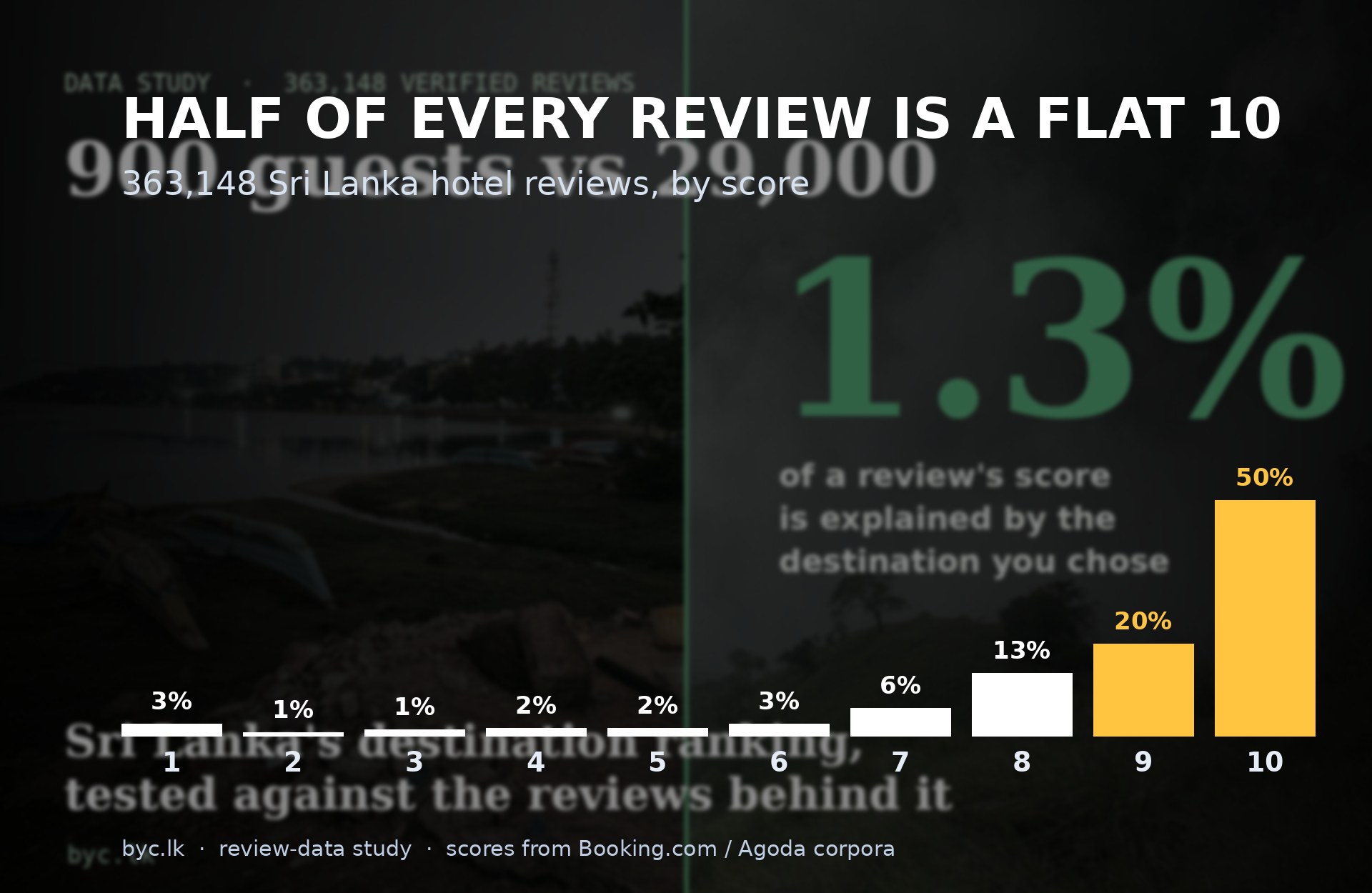
Short answer: a single 10/10 is weak evidence, and the number on the card tells you less than the review's shape. Across 363,148 Sri Lanka hotel reviews, 70% score 9 or 10 and 50% score a flat 10 — so on a 10-point scale, half the island shares the top grade. Meanwhile 29% of reviews have a clicked menu label ("Exceptional", "Good", "Passable") instead of a written headline, and 92,410 reviews have no text at all. The reviews that score lowest are the long ones: reviews over 1,500 characters average 6.2, against 8.8 for 100–199 characters.
What to do with it: read the 1,000-word reviews first — on this corpus they are the most critical and the most specific. Treat "Exceptional" with no text as a click, not an opinion. And check the count of reviews, not the average: two 10s is not a rating.
Every traveller in Sri Lanka does the same thing at 9pm on a booking site: reads the score, scans two reviews, and decides. The score looks precise — 9.4, 8.8, 9.6 — and the reviews look unanimous. This study asks whether either of those things is true, using the corpus we have: 363,148 guest reviews across 1,760 Sri Lankan properties and 50 destinations, with the reviewer's own score attached to every one.
The short version: the average is real, but it is not measuring what you think it is measuring. A 10 on an accommodation site is not "perfect" — it is "nothing went wrong that I am prepared to write about". Once you accept that, the useful signal moves from the score to the shape of the review, and this page is about the three shapes that matter.
First: the scale is not a scale
Here is the full distribution of 363,148 reviews on the 10-point scale. It is not a bell curve, a normal distribution, or anything resembling a measurement instrument. It is a spike at the top with a long tail.
| Score | Reviews | Share | |
|---|---|---|---|
| 1 | 9,429 | 2.6% | |
| 2 | 3,106 | 0.9% | |
| 3 | 5,048 | 1.4% | |
| 4 | 6,453 | 1.8% | |
| 5 | 6,089 | 1.7% | |
| 6 | 9,327 | 2.6% | |
| 7 | 21,176 | 6.0% | |
| 8 | 47,854 | 13.4% | |
| 9★ | 69,610 | 19.6% | |
| 10★ | 177,700 | 49.9% |
83.0% of all reviews score 8, 9 or 10. 49.9% score exactly 10. For comparison, 17.0% of the corpus occupies the entire range from 1 to 7 — seven of the ten points are used by one review in six.
This is not a Sri Lanka problem; it is how accommodation scales are used everywhere. But it has a specific consequence here: when 70% of reviews sit in two adjacent cells, a property's average is decided by the mix of 8s, 9s and 10s, not by whether guests were happy. A hotel at 9.4 and a hotel at 8.9 may be the same hotel on different weeks.
Second: a third of the "reviews" are a clicked menu
When a guest finishes a stay, the platform offers a list of words to click as a summary. Those words are printed as the review's headline. They are not adjectives the guest chose in a sentence — they are the shortest available answer to "rate it", and they map almost mechanically onto the score.
| Headline (clicked label) | Reviews | Mean score | Share scoring 9–10 | Share scoring 7 or below |
|---|---|---|---|---|
| Exceptional | 65,142 | 9.99 | 100.0% | 0.0% |
| Excellent | 5,234 | 9.10 | 92.4% | 0.1% |
| Very good | 22,620 | 7.95 | 0.8% | 5.3% |
| Good | 9,091 | 7.07 | 2.5% | 95.5% |
| Passable | 2,262 | 5.00 | 0.0% | 100.0% |
| Poor | 1,777 | 3.00 | 0.0% | 100.0% |
| Very poor | 984 | 2.00 | 0.0% | 100.0% |
Look at the middle of that table. "Very good" averages 7.95. "Good" averages 7.07 — and 95% of "Good" reviews score 7 or below. On this scale, "Good" is not a compliment. It is the polite form of a complaint, and it is the label a guest picks when the stay was acceptable and they do not want to write anything.
Now the number that reorganises the whole corpus: 107,110 reviews (29.5%) carry one of these menu labels as their headline, and 56.5% of them have under 60 characters of body text. They average 8.98. The 118,495 reviews with a genuinely written headline (more than 25 characters) average 8.61 — a 0.37-point gap. The reviewers who said the least rated the highest.
That gap is the single most useful thing in this study, and it is not about Sri Lanka at all. It is about what a score means when it takes one click to produce.
Third: the length of a review predicts its score — backwards
If scores were honest measurements, review length would be uncorrelated with them: happy and unhappy guests would both write, at different rates but with similar average effort. What the corpus shows is an inverted U. Reviews of 100–399 characters — a paragraph, written by someone with something specific to say — score highest. Long reviews score lowest.
| Body length | Reviews | Mean score | Share scoring 7 or below |
|---|---|---|---|
| 0–39 chars | 77,605 | 8.63 | 18.1% |
| 40–99 chars | 102,420 | 8.47 | 19.9% |
| 100–199 chars | 67,590 | 8.85 | 13.4% |
| 200–399 chars | 66,537 | 8.92 | 12.4% |
| 400–799 chars | 35,019 | 8.73 | 15.8% |
| 800–1499 chars | 9,120 | 8.03 | 26.4% |
| 1500+ chars | 4,857 | 6.20 | 46.8% |
The reviews over 1,500 characters average 6.2 and 46.8% of them land at 7 or below — nearly 2.6x the rate of the shortest band. This is not because long reviews are written by harsh people. It is because a guest who had a complicated stay has more to explain. Nobody writes 2,000 words about a room that was fine.
Meanwhile 37,216 reviews — 20.9% of all the 10s on the site — score a perfect 10 with a body under 40 characters. Many have no body at all: 92,410 reviews in the corpus have empty or placeholder text ("Nothing", "No comments").
The practical rule: read length, not score
If you only change one habit, change this one. In descending order of information value:
- Read the long reviews. 800+ characters is where the maintenance problems, the road noise, the shuttle that did not come and the shower that ran cold are written down. On this corpus those reviews average 8.0 — and that is the honest number, not the inflated one.
- Count reviews, not stars. A property with 4 reviews and a 9.8 is a property with 4 reviews. Our destination studies already show what happens when a ranking rests on a thin sample: Batticaloa's ranking is built on 12 properties.
- Ignore menu-label-only reviews for sentiment ("Exceptional" with 30 characters). They are clicks. They carry the score of a click, which is why the menu population averages 8.98.
- Read the 7s. On a scale where the median is 9 or 10, a 7 is not "average" — it is a guest telling you what went wrong in the least confrontational way available. 95% of "Good" reviews already live there.
What a long negative review is actually about
One more split worth seeing. Among reviews scoring 7 or below, average text length varies by destination by a factor of more than 1.4. These are the destinations where the people who complain write the most about it:
| Destination | Low-score reviews | Average characters |
|---|---|---|
| Kalpitiya | 463 | 748 |
| Sinharaja | 276 | 732 |
| Habarana | 428 | 612 |
| Unawatuna | 1,573 | 588 |
| Chilaw | 178 | 587 |
| Matara | 478 | 582 |
| Hambantota | 204 | 554 |
| Arugam Bay | 1,357 | 553 |
Kalpitiya, Sinharaja and Habarana lead. These are not the destinations with the worst reviews — the risk study published separately shows the opposite, Habarana has one of the smallest bad tails on the island. What they share is that a stay there is remote: a lagoon, a rainforest, a road with no alternative. When something goes wrong in a place you cannot walk out of, you write it down at length. In a beach town with thirty hotels on the same road, you give the room a 6 and move on.
Do the reviews contradict themselves?
We also tested the most damning hypothesis anyone has about review scores: that a 10 is written by someone who also had a complaint. Among 59,345 high-scoring reviews (9 or 10) that carry a real written headline, only 225 — 0.38% — contain a negative word ("however", "but the", "unfortunately", "not worth", "noisy", "dirty") in their headline. Higher in the hill country and Colombo, lowest in Ella and Yala.
0.38% is small, and it is the best news in this study: the score inflation we measured is not being produced by guests complaining in the title and scoring 10 anyway. The inflation happens at the click, not in the sentence. Guests who write a sentence write an honest one.
The other habit worth noting is repetition. Some reviews are a run of clicked labels joined together — "Exceptional | Exceptional | Wonderful apartments | Exceptional". That format appears on 3,166 reviews, 3,019 of which (95.4%) repeat at least one word three or more times. Their average score is 6.09. The single most common repeated word is "exceptional".
What this means for choosing a hotel in Sri Lanka
Two conclusions, one for travellers and one for the properties being rated.
If you are booking: the score is a filter, not evidence. Use it to remove the bottom decile, then stop looking at it. The decision that actually predicts your stay is in the text: how the water is heated, whether the room is on the road, whether the property planned for insects, whether the shuttle showed up. We wrote those questions up in the study of what actually breaks a stay — the amenities table there is the practical companion to this page.
If you are hosting: your score is compressed against everyone else's, so it cannot differentiate you. What differentiates you is being readable. A property whose 9.3 comes from forty guests describing a specific thing well (the breakfast, the walk to the beach, the host) will be chosen over one whose 9.5 comes from sixty clicks.
Limits of this study
We can see who reviewed, not who was asked. Review request timing, platform prompting and the reviewer's incentive all affect what appears, and none of them are visible in this dataset. The label table measures the labels as printed on Sri Lankan properties in this corpus, not the platform's intentions. Length is a proxy for effort, and effort is a proxy for engagement — a short review can be entirely honest, and a long one can be entertainment. The contradiction test is keyword-based and therefore a floor: it only catches a negative word in the headline, not a complaint buried in paragraph four. Menu labels are matched on exact headline text, so a guest who typed "Exceptional location" counts as a written review, not a click. Finally, everything here is a description of a corpus of reviews about Sri Lanka, not an audit of whether any individual hotel is good — for that, read the long ones.
Continue the series: the review statistics hub, what breaks a stay, the risk of each destination, is a destination rating meaningful, what 337,151 headlines say, or price a trip with the budget calculator and match a destination with the destination matcher.
Have a specific question about your Sri Lanka trip?
Ask BYC at byc.lk — Free and honest. Some links are affiliate links and never change our advice.
Ask BYC Your Question →