Sri Lanka SIM Card Price 2026: What a Gigabyte Actually Costs
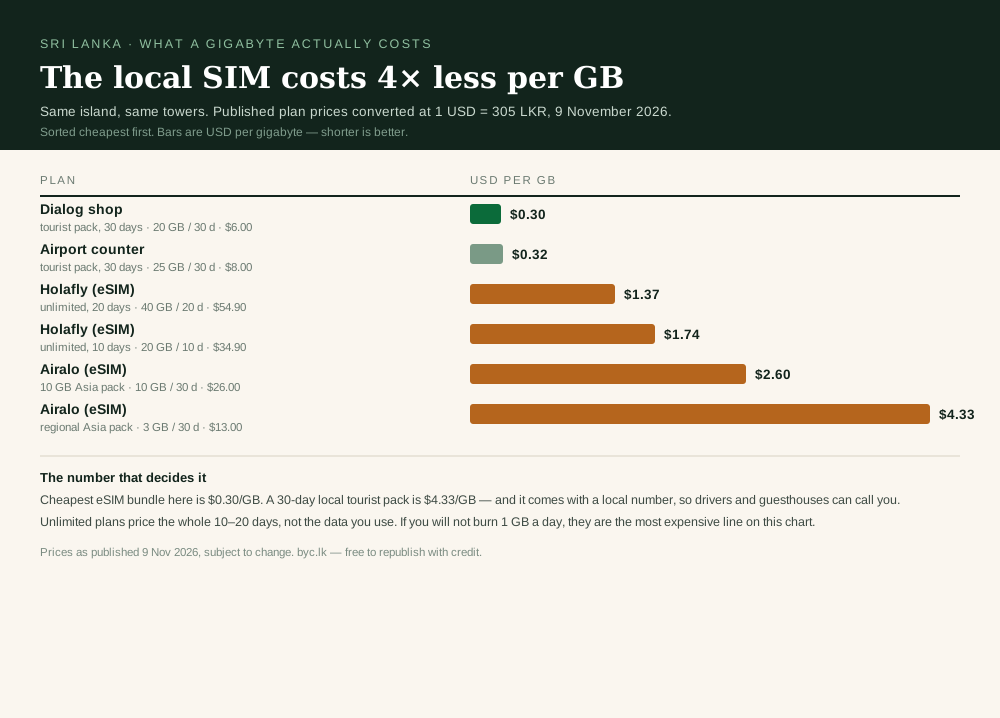
The short answer: a 30-day tourist SIM bought in Sri Lanka costs roughly 1,500–2,500 LKR (about $5–8) for 20–30 GB, and it comes with a local phone number. An international eSIM for the same trip costs $10–20 for 10–20 GB and is data-only. The local SIM is the better buy on every measure except the queue at the airport — and that queue is the only reason eSIMs sell at all.
This page is the price table, not the opinion piece. It gives you what each option costs per gigabyte as of 9 November 2026, what you give up at each price point, and what 363,148 hotel reviews say about needing your own data in the first place. If you want the step-by-step of buying one, the SIM card how-to covers the counter, the paperwork and the activation.
The price table
Prices are as published by each provider on 9 November 2026, converted at 1 USD = 305 LKR. Local prices move with the rupee; if you are reading this months later, treat the rupee column as indicative and the per-GB column as the shape of the answer.
| Option | What you get | Price | USD/GB | Local number |
|---|---|---|---|---|
| Dialog tourist pack Dialog shop, in town | 20 GB + local calls, 30 days | ~1,830 LKR ≈ $6.00 | $0.30 | Yes |
| Airport counter Dialog or Mobitel, arrivals hall | 25 GB + local calls, 30 days | ~2,440 LKR ≈ $8.00 | $0.32 | Yes |
| Mobitel tourist pack Mobitel shop | 20 GB + local calls, 30 days | ~2,135 LKR ≈ $7.00 | $0.35 | Yes |
| Airalo eSIM regional Asia pack | 10 GB, 30 days, data only | $26.00 | $2.60 | No |
| Airalo eSIM 3 GB starter | 3 GB, 30 days, data only | $13.00 | $4.33 | No |
| Holafly eSIM unlimited, 10 days | Unlimited data, 10 days | $34.90 | ≈ $1.75 if you use 20 GB | No |
| Holafly eSIM unlimited, 20 days | Unlimited data, 20 days | $54.90 | ≈ $1.37 if you use 40 GB | No |
Two things in that table are worth pausing on, because they are where money is lost:
- The small eSIM packs are the worst value on the island. A 3 GB eSIM at $13 is $4.33 a gigabyte — fourteen times the per-GB price of a local pack. It is fine as a first-24-hours bridge and bad as a trip plan.
- "Unlimited" is only cheap if you actually use it. The Holafly rows are per-GB estimates at 2 GB a day, which is roughly double what a normal traveller burns on maps, messaging and booking apps. At a realistic 1 GB a day, the 10-day plan is about $3.50/GB and still two-thirds more than buying 30 days of local data.
Dialog or Mobitel — does the operator choice matter?
Dialog is the larger network and the safer default for a loop of the island: hill country, east coast, deep south, and the national parks. Mobitel is the incumbent, excellent in places, patchier in others, and typically a touch more per gigabyte on tourist packs. Hutch and Airtel are cheaper and thinner outside cities — a false economy for a two-week trip that spends time in Ella, Yala or Arugam Bay.
What the reviews say about coverage
We hold 363,148 verified Sri Lanka hotel reviews. We searched all of them for SIM, data, signal and coverage language — separate from Wi-Fi complaints — to see whether the places where guests most often needed their own data are also the places where the networks thin out.
| Signal finding | Reviews | Mean score | vs corpus |
|---|---|---|---|
| Mentions Wi-Fi at all | 5,807 | 7.23 | -1.41 |
| Mentions mobile signal / data / coverage | 4,708 | 6.65 | -1.99 |
| Says the Wi-Fi did not work | 810 | 4.32 | -4.32 |
| Praises the Wi-Fi | 1,035 | 8.92 | +0.28 |
| Corpus average | 363,148 | 8.642 | — |
The gap between "the Wi-Fi did not work" (4.32) and "the Wi-Fi was great" (8.92) is 4.6 points on a 10-point scale — wider than most destination rankings on this site. That is the argument for buying data before you need it: the hotels where the Wi-Fi fails are not evenly distributed, and you find out which one you booked at 9pm, not at check-in.
Where guests needed their own data most
Below are the regions with at least 2,000 reviews where Wi-Fi gets mentioned most and complained about hardest. Mentions is how often reviewers raised it at all — a proxy for how noticeable it was, good or bad. A high complaint share with low praise is a place to plan for offline maps before you arrive.
| Region | Reviews | Mentions | Negative | Positive |
|---|---|---|---|---|
| Haputale | 4,248 | 2.26% | 22.9% | 7.3% |
| Dambulla | 8,520 | 1.89% | 18.6% | 13.7% |
| Kalpitiya | 3,022 | 2.78% | 17.9% | 4.8% |
| Colombo | 34,262 | 1.21% | 17.5% | 15.4% |
| Yala | 15,820 | 1.68% | 16.2% | 8.3% |
| Polonnaruwa | 5,900 | 2.8% | 15.2% | 26.1% |
| Nilaveli | 5,529 | 3.83% | 14.6% | 8.5% |
| Jaffna | 4,535 | 2.36% | 14.0% | 23.4% |
Plan accordingly: download offline Google Maps for the hill country and the park approaches, and treat your phone's hotspot as the backup rather than the plan.
Buying at the airport versus in town
The airport counter is roughly 600 LKR (about $2) more than a Dialog shop in Negombo or Colombo for a comparable pack — and it is still the right choice for most arrivals. The reason is not price, it is failure: a card activated in front of you at 3am works before your first tuk-tuk ride. Buying in town the next morning means one night with no map and no way to message anyone.
If you are staying near the airport on your first night — Common first-night choices are Negombo and Waikkal — then buying in town the next morning is genuinely fine. You already have one night's Wi-Fi at the hotel.
What to bring to the counter
- Your physical passport. Sri Lanka registers prepaid SIMs against ID. In most cases a photo on your phone is not accepted.
- Five to ten minutes. Staff install the SIM, wait for the activation SMS and test a data connection. Let them.
- Your trip length. Plans sell in 7, 14 and 30-day windows. Buying 7 days for a 10-day trip is the most common avoidable mistake — and the most common reason people end up paying for an eSIM top-up mid-holiday.
- Cash or card. Both work at the airport counters and at official shops.
The hybrid most people actually use
The plan that gets the best of both: buy a small eSIM before you fly to cover the flight and the first taxi, and a local physical SIM on day one for the rest of the trip. Keep your home number on the eSIM line so bank and airline messages still arrive. That way you never land without data, and you never pay eSIM per-GB prices for two weeks of maps.
When the eSIM is genuinely the better buy
- Short trips. Three or four days, hand luggage only, no intention of calling anyone: the $13 eSIM is one less queue and the per-GB penalty is small in absolute terms.
- Device without a SIM tray. Newer phones in some markets are eSIM-only; check before you plan around a physical card.
- Work calls on a known network. If your employer or VPN requires a specific carrier route, an eSIM that roams on a partner network may be the only option that behaves.
Questions people ask
How much should I budget for mobile data in Sri Lanka?
About $6–8 for the whole trip on a local tourist pack. Anything above $20 for connectivity on a two-week holiday means you bought an eSIM, not a SIM.
Is an eSIM cheaper than a local SIM in Sri Lanka?
No. Per gigabyte, a local tourist pack is roughly four to fourteen times cheaper depending on which eSIM pack you compare it with. The eSIM's advantage is convenience and arriving connected, not price.
Can I get a SIM card at Colombo airport?
Yes — Dialog and Mobitel both have counters in the arrivals hall, open for late-night arrivals, and they activate the SIM in front of you in five to ten minutes. Expect to pay a few hundred rupees more than in town.
Do I need a local number, or is data enough?
Data covers maps, rides and messaging apps. A local number matters when a guesthouse, driver or activity operator wants to call you — which happens more often than travellers expect, particularly for transfers and safari pickups.
Does my hotel Wi-Fi make a SIM unnecessary?
Sometimes. Reviews that say the Wi-Fi did not work average 4.32/10 against a corpus average of 8.642, and the regions in the table above are where it fails most. If your itinerary is heavy on the hill country and the parks, assume you will need your own data for at least part of the trip.
Built from the same review corpus used across byc.lk. How the numbers were made: plan prices read from each provider's published 2026 rate card on 9 November 2026 and converted at 1 USD = 305 LKR; the review figures are computed directly from 363,148 verified guest reviews and are reproducible. This page is not sponsored and carries no affiliate preference — see the Wi-Fi and working-from-Sri-Lanka study and the SIM card how-to for the rest of the cluster.
Have a specific question about your Sri Lanka trip?
Ask BYC at byc.lk — Free and honest. Some links are affiliate links and never change our advice.
Ask BYC Your Question →