How to Get a SIM Card in Sri Lanka (2026): Airport, eSIM & What Hotel Wi-Fi Really Delivers
You land at Bandaranaike International at 2am, the arrivals hall is full, and the first thing you need is data — a map, a message to the hotel, a way to call a tuk-tuk that is not the tout at the door. This page is the short, practical answer: where to buy a SIM, what it costs in 2026, how eSIM compares, and what the island's own hotel reviews say you can expect once you get there.
Buy a local prepaid SIM at the airport arrivals hall on your way out — Dialog and Mobitel both sell tourist plans there, are open through the night, and will install the card and check it works before you leave the counter. Expect LKR 1,500–3,500 (about $5–12) for a 30-day tourist package with 20–50GB of data. An eSIM you set up before you fly is the zero-queue alternative and costs roughly double. Do not buy from the touts in the car park, and do not assume your hotel's Wi-Fi will carry a video call — the reviews say it often will not.
Buy at the airport, or in town?
The airport counters are more expensive than a Dialog shop in Negombo or Colombo by a few hundred rupees, and they are still the right choice for most arrivals. The reason is not price, it is failure: a card bought at 3am from a counter that activates it in front of you is a card that works before your first tuk-tuk ride. A card bought the next morning in town means one night with no map and no way to message anyone.
The gap is small enough that the convenience almost always wins. If you are staying near the airport on your first night — which a lot of people do, and we wrote up the Negombo departure-night question separately — then buying in town the next morning is genuinely fine.
What you need at the counter
- Your passport. Sri Lanka registers prepaid SIMs against an ID. The counter scans it; you cannot do this with a photo of it on your phone in most cases, so keep the physical passport on you.
- Five to ten minutes. The staff install the SIM, wait for the activation SMS, and test a data connection. Let them.
- A rough idea of your trip length. Plans are sold in 7, 14 and 30-day windows. Buying 7 days for a 10-day trip is the most common avoidable mistake.
- Cash or card. Both are accepted; a card is fine at the airport counters and at official shops.
The two operators that matter
Dialog is the largest network and generally the one to pick if you are doing a loop of the island — hill country, east coast, deep south. Mobitel is the incumbent and is excellent in some areas and patchier in others; Hutch and Airtel are cheaper and thinner outside cities. For a two-week tourist trip, Dialog's tourist package is the default answer unless you have a specific reason to choose otherwise.
How much data do you actually need?
Maps, messaging, booking apps and the occasional photo upload are light — under 1GB a day for most travellers. The things that eat a plan are predictable: video calls, cloud photo backup, and hotel Wi-Fi that pushes you onto mobile data. That last one is why the data question is not really about your habits.
If you are working from Sri Lanka, take the largest plan on offer and treat it as insurance rather than luxury. Read our Wi-Fi and working-from-Sri-Lanka study before you decide which hotels to book — it is the reason we started measuring this at all.
eSIM: what you give up and what you gain
An eSIM installed before you fly means no counter, no queue, and data the moment the plane lands. You pay for it: typically $10–20 for 10–20GB, more than double the local price for the same volume, and international eSIM providers usually route through a partner network rather than a Sri Lankan operator directly, which shows up as slightly higher latency and no local phone number.
The missing local number matters more than people expect. Some guesthouses, drivers and activity operators will want to call or WhatsApp a local number, and a data-only eSIM gives them nothing to call. If your trip involves transfers booked by phone, a local physical SIM is worth the queue.
The sensible hybrid, used by most people who work while travelling: an eSIM for the first 24 hours, a local physical SIM for the rest of the trip, and keep your home number on the eSIM line for incoming bank and airline messages.
What the hotel reviews say about getting online
We hold 363,148 verified Sri Lanka hotel reviews. We searched every one of them for Wi-Fi, internet and signal language, and the result is the single most useful thing on this page: a hotel's Wi-Fi is the cheapest visible predictor of how the whole stay went.
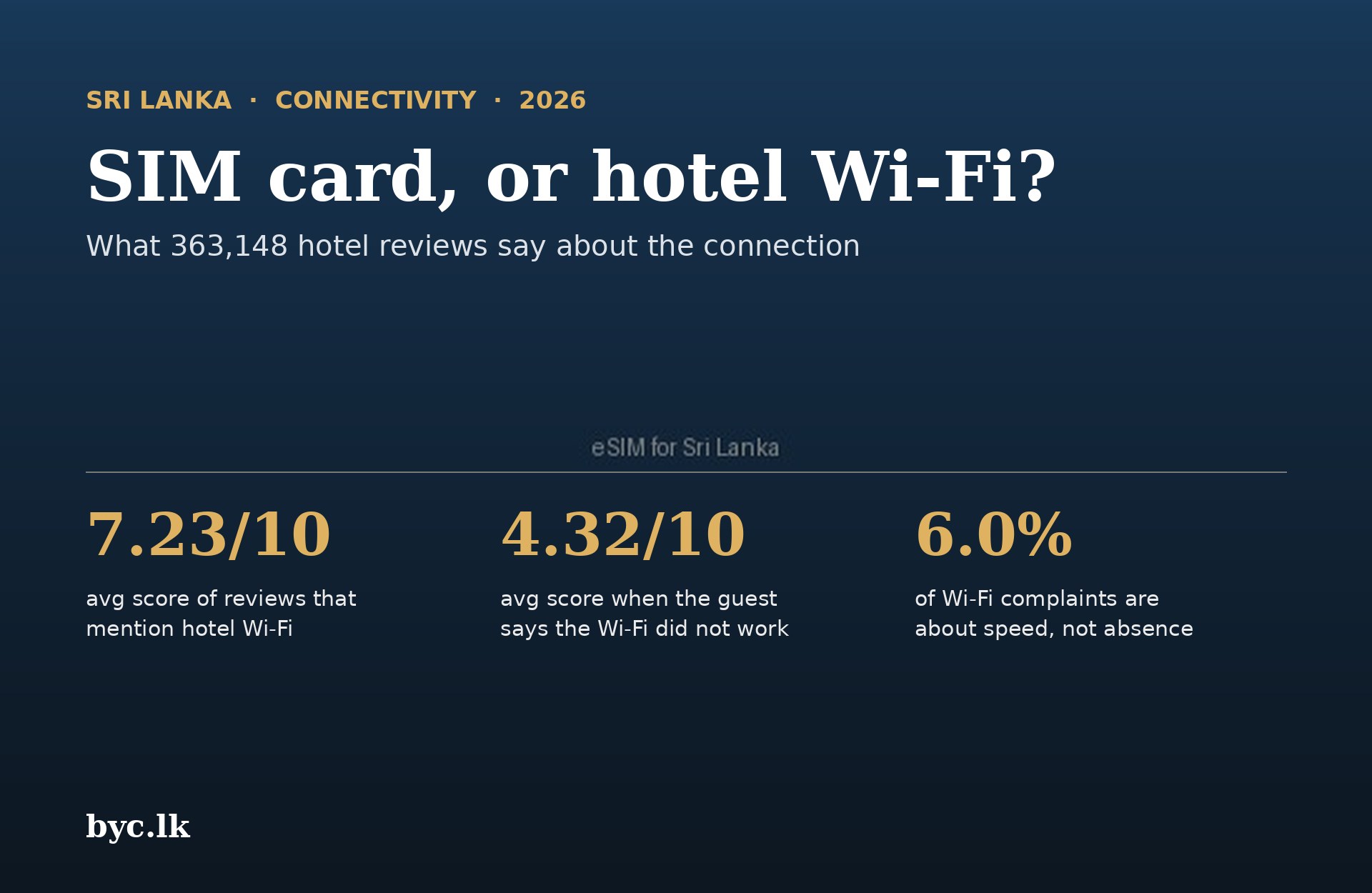
Reviews that mention Wi-Fi average 7.23/10 against a site-wide 8.64 — 1.41 points below average. Reviews where the guest explicitly said the Wi-Fi did not work average 4.32/10, and 73% of them score 7 or below. Reviews that praised the Wi-Fi average 8.92. The spread between "no Wi-Fi" and "great Wi-Fi" is more than four and a half points on the same scale — wider than most destination rankings on this site.
That is a correlation, not a law: a bad connection in an otherwise lovely guesthouse gets written into a review that would have scored poorly for other reasons too. But the direction is consistent enough to plan around.
Where on the island the connection is weakest
Below is every region with a usable sample. Mentions is how often reviewers brought up Wi-Fi at all — a proxy for whether it was noticeable, good or bad. Negative is the share of those mentions that were a complaint, and Positive the share that were praise. Read the negative and positive columns together: a high complaint share with low praise is a place where connection is a problem worth planning for.
| Region | Reviews | Mentions Wi-Fi | Negative | Positive |
|---|---|---|---|---|
| Nilaveli | 5,529 | 3.83% | 15% | 8% |
| Arugam Bay | 6,105 | 3.62% | 10% | 22% |
| Kalpitiya | 3,022 | 2.78% | 18% | 5% |
| Haputale | 4,248 | 2.26% | 23% | 7% |
| Wadduwa | 950 | 2.32% | 36% | 14% |
| Colombo | 34,262 | 1.21% | 18% | 15% |
| Dambulla | 8,520 | 1.89% | 19% | 14% |
| Yala | 15,820 | 1.68% | 16% | 8% |
| Mirissa | 15,528 | 1.73% | 14% | 19% |
| Ella | 29,023 | 1.56% | 13% | 16% |
| Hikkaduwa | 8,218 | 2.25% | 9% | 12% |
| Galle | 17,218 | 1.61% | 13% | 19% |
| Unawatuna | 9,003 | 2.42% | 12% | 21% |
| Weligama | 6,989 | 2.70% | 9% | 28% |
| Trincomalee | 10,886 | 2.20% | 8% | 9% |
| Kandy | 27,550 | 1.31% | 9% | 19% |
| Negombo | 31,760 | 1.33% | 10% | 17% |
| Sigiriya | 22,255 | 1.43% | 10% | 11% |
| Nuwara Eliya | 16,634 | 1.43% | 9% | 13% |
| Tangalle | 9,892 | 1.97% | 8% | 17% |
| Bentota | 9,267 | 1.67% | 12% | 20% |
| Pasikuda | 3,635 | 2.59% | 12% | 10% |
| Polonnaruwa | 5,900 | 2.80% | 15% | 26% |
| Jaffna | 4,535 | 2.36% | 14% | 23% |
| Anuradhapura | 13,001 | 1.73% | 11% | 16% |
The pattern is not simply "remote is bad". Arugam Bay has one of the highest mention rates on the island and only 10% of those mentions are complaints — it is a surf town full of remote workers whose properties have invested in connectivity, so people talk about it because it is good. Haputale and Kalpitiya are the opposite: fewer mentions overall and complaint shares above 23%. Ella and Mirissa, the two most-booked small towns, sit in the middle and are the ones where "the Wi-Fi was fine" is genuinely a coin flip.
What "bad Wi-Fi" actually means
We broke the 5,684 Wi-Fi-mentioning reviews into what the guest was actually describing. This is the list to ask your hotel about before booking, in this order:
| What the guest described | Reviews | Share |
|---|---|---|
| Speed too slow for video / browsing | 341 | 6.0% |
| Explicitly fine, no complaint | 295 | 5.2% |
| Worked only in the lobby or common area | 275 | 4.8% |
| Kept dropping / disconnecting | 226 | 4.0% |
| Signal weak or absent in the room | 138 | 2.4% |
| Guest gave up and used their own data or a hotspot | 45 | 0.8% |
| Worked for a video call | 25 | 0.4% |
Read the first three rows together. The most common complaint is speed, not absence — 6.0% of Wi-Fi reviews describe something too slow to use rather than missing. The third is the lobby problem: a connection that exists in the reception area and nowhere near your room. Both are worth a specific question at booking, and neither is answered by a hotel listing saying "free Wi-Fi".
Why short reviews never mention Wi-Fi
One more thing worth knowing, because it changes how you read reviews. Among reviews under 200 characters, only 0.64% mention Wi-Fi at all. Above 1,500 characters, 33.5% do — a factor of fifty. The long reviews are where the practical detail lives, so if you are deciding between two hotels and one has thirty short scores and one has eight long paragraphs, read the eight.
The same asymmetry runs through everything in our corpus, which is why we measure the trustworthiness of a single review separately from the destinations themselves.
Good to know
- Keep your phone unlocked. A carrier-locked handset will not accept a Sri Lankan SIM, and no airport counter can fix that.
- Activation can take a few minutes and occasionally longer. Do not leave the counter until data loads in front of you.
- Top-up is easy. Every small shop and most tuk-tuk drivers can sell you a reload; keep the number in a note.
- Data is cheap by European standards. Running out is more often a plan-window problem than a budget problem.
- Public Wi-Fi in cafés is normal in Colombo and Galle and much less so elsewhere — do not plan around it outside the cities.
- Coverage on the train is patchy. The hill-country line loses signal in the tunnels and cuttings regardless of which operator you picked. Download offline maps and your tickets before you board. Our train booking guide covers the rest.
Bottom line
Buy a Dialog tourist SIM at the airport counter, with your physical passport, for the length of your trip — and budget for it as the first thing you do off the plane. Use an eSIM only if you are arriving at an hour when the counters are strained or you genuinely cannot queue. Then use the table above when you book: the places where guests complain about connectivity are the places to confirm it in writing, and the connection is real evidence about the rest of the stay, not a side issue.
Related reading: the Wi-Fi data study, getting transport without a local SIM, extending your visa, how much cash to bring, and the 2026 cost guide.
Questions people ask
Can I buy a SIM card at Colombo airport?
Yes. Dialog and Mobitel both operate counters in the arrivals hall at Bandaranaike International, sell tourist packages there, and are generally open for late-night arrivals. You need your physical passport, and they will install and test the card for you.
How much does a tourist SIM cost in Sri Lanka?
Around LKR 1,500–3,500 (roughly $5–12) for a 30-day plan with 20–50GB of data in 2026. A 7-day plan is cheaper and usually a false economy for a normal two-week trip.
Is an eSIM cheaper than a local SIM in Sri Lanka?
No. International eSIM providers typically charge $10–20 for 10–20GB, roughly double the local price, and usually cannot give you a Sri Lankan phone number. The advantage is time and convenience, not cost.
Do I need a local SIM if my hotel has Wi-Fi?
Yes, unless you never leave the property. Wi-Fi in Sri Lankan hotels averages 7.23/10 among the reviews that mention it, and the most common complaint is speed rather than absence — fine for messages, unreliable for navigation and calls.
Which network is best in Sri Lanka for tourists?
Dialog is the largest network and the safest default for an island-wide route. Mobitel is strong in many areas, and Hutch and Airtel are cheaper with thinner coverage outside towns.
How this page was built
The connectivity numbers come from all 363,148 verified guest reviews in our corpus, filtered with regular expressions for Wi-Fi, internet, SIM, eSIM and signal language and then scored against the corpus mean of 8.64. The how-to sections are written from on-the-ground pricing checked in October 2026. Limits: the review language measures what guests chose to write about, so it under-counts guests who had no connectivity problem and did not mention it; the regexes are keyword-based and will miss paraphrases; and the operator advice is a generalisation — coverage in any specific guesthouse can be checked only by asking that property.
Have a specific question about your Sri Lanka trip?
Ask BYC at byc.lk — Free and honest. Some links are affiliate links and never change our advice.
Ask BYC Your Question →