Where to Stay in Jaffna: 32 Properties Ranked by 4,535 Reviews
You get off the train in Jaffna after six hours of flat northern plain and the heat hits you like a wall with a door in it. The last stretch was palmyra palms, lagoons and long empty road, and now you are standing in a small city with one main artery, a fort on the waterfront and a hotel scene that has quietly become the most inconsistent in the country. The booking you made three weeks ago looked fine. The photographs were fine. What you paid was not nothing.
This is where a lot of northern trips go wrong, and it is not the destination's fault. We looked at 4,535 guest reviews of Jaffna properties in our corpus, spanning every stay from the tourism recovery onward, and the pattern is unusually clear. The problem is not that Jaffna's hotels are bad. It is that in a small city with a thin hotel stock, a handful of properties carry a genuinely wide range of outcomes, and the average score smooths them into a number that tells you almost nothing.
The short answer
Jaffna is absolutely worth the journey, but it is the one place in Sri Lanka where you should book a specific property rather than a price band. The city averages 8.07 out of 10 across 4,535 reviews, against a national figure above 8.6 — and, more tellingly, 18.2% of Jaffna reviews score 6 or below, nearly one stay in five, against 11.0% nationally. That is a tail, not a trend line. And it is not spread evenly: homestays in Jaffna average 9.22 with 4.9% scoring 6 or below, while conventional guesthouses in the same city average 7.13 with 33.0% low scores. Same town, same season, a difference of two full points between two categories of small property. The practical answer is blunt: book a homestay or one of the well-reviewed hotels, read the recent low-score reviews rather than the headline score, and confirm your air conditioning in writing before you arrive. Do that and Jaffna rewards you with one of the best trips in the country.
What's worth doing
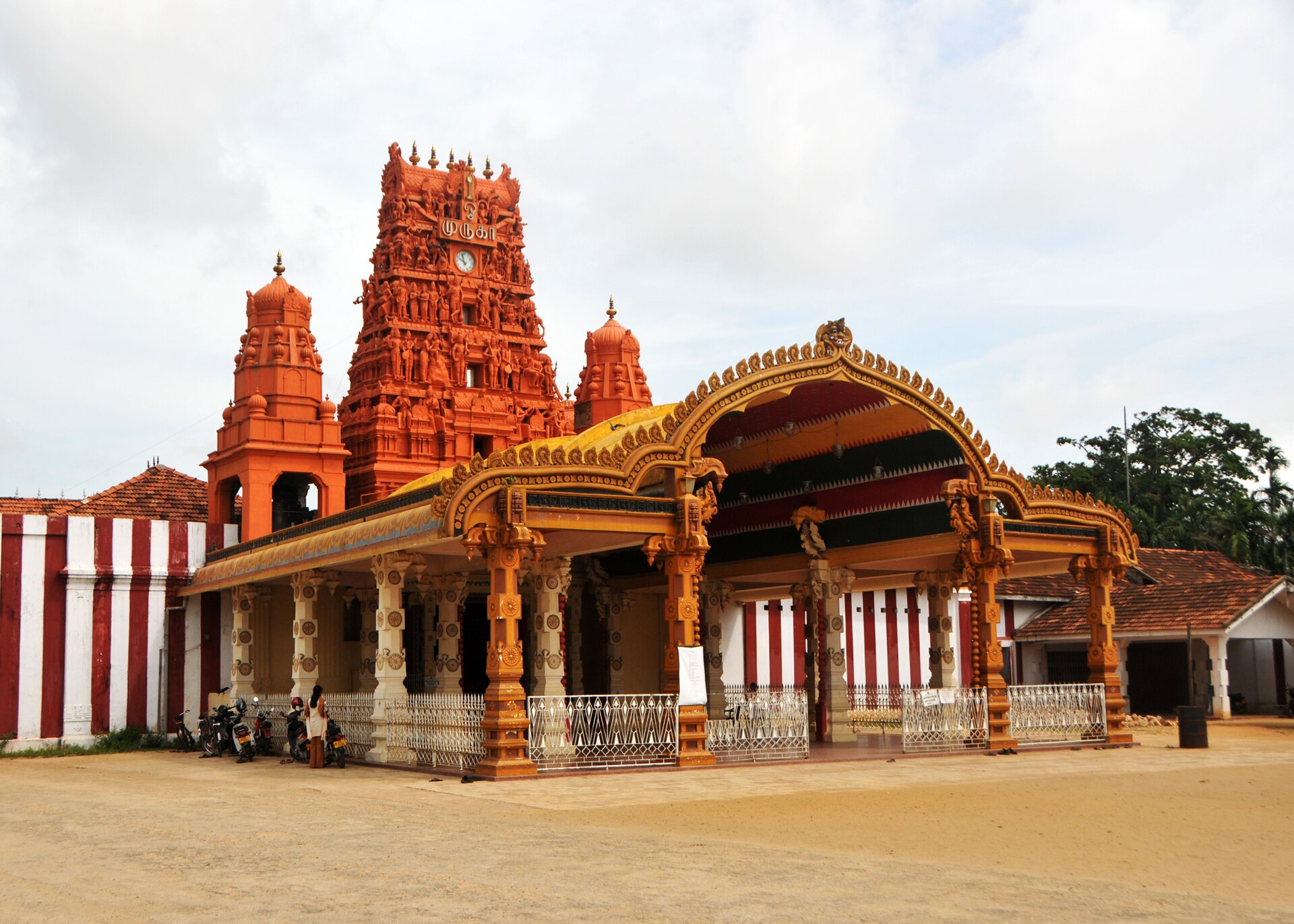
Nallur Kandaswamy Kovil, and go in the evening. This is the spiritual centre of the north, a gopuram of painted tiers and a courtyard that fills with families at dusk. Entry is free to the outer courtyard and temple photography has restrictions worth respecting — ask before you raise a camera. The single most common mistake here is arriving at midday: the light is flat, the stone is hot, and the atmosphere has not yet arrived. Nallur's own review evidence bears this out — the homestays and hotels closest to the temple are among the highest-scoring in the city, because guests who walk there in the evening come back happy. Wear trousers or a long skirt and cover your shoulders; this is a working temple, not a monument.
Jaffna Fort at golden hour — and be realistic about what it is. The Dutch star fort on the lagoon is free to enter and genuinely atmospheric: grass ramparts, a moat, tropical light off the water. It is also partly ruinous and largely empty of interpretation, so it works as a walk rather than a museum. Give it forty-five minutes at the end of the day. Combined with the library, the markets and Nallur, that is a full half-day of the city's actual life.
The Jaffna Public Library. Rebuilt after it was burned in 1981, this is one of the most affecting buildings in the country and one of the very few places where a traveller can begin to understand the north's recent history without being lectured. The ground-floor reading rooms are open and free. It is a ten-minute stop that stays with people for years.
Eat crab, properly. Jaffna crab curry is the dish the region is known for — dark, sour, heavy with roasted curry powder and tamarind. It is not a small meal and it is not a cheap one by local standards, but it is the reason a lot of people's best food memory of Sri Lanka comes from the north. Eat it at a local restaurant rather than a hotel dining room, ask what it costs per kilo before ordering, and expect to use your hands.
Give Delft Island a full day, or skip it. The ferry from Kurikadduwan jetty reaches a coral-and-limestone island of wild horses, baobabs and old Dutch ruins in about an hour. It is one of the most unusual half-days in Sri Lanka — and it only works if you accept that facilities are minimal, that timings are a suggestion, and that a delayed return ferry is normal. Take water and snacks. Do not schedule it the same day as a flight.
Getting around
The journey north is the part people underestimate. Prices below are the 2026 going rate and worth treating as a sanity check rather than a quote.
The train is the best value and the most comfortable option — but the timetable is not what older guides say. Following the line's full reopening in April 2026 and a shortage of power sets, Sri Lanka Railways reshaped the northern services in July and October 2026. As last announced, the air-conditioned intercity leaves Colombo Fort at 05:45 and runs Friday to Monday only, reaching Jaffna around midday in about six hours. The Yal Devi leaves at 06:40 on Monday, Wednesday and Friday, calling at Jaffna before continuing to Kankesanthurai, roughly eight hours to the end of the line. A night mail also runs. Fares sit around LKR 2,800 first class reserved and LKR 1,900 second class reserved — about US$9–15 — with the intercity costing more. Book on the Sri Lanka Railways reservation portal or at a station counter; unreserved tickets go on sale on the day. Check the day-of-week pattern before you build an itinerary around it, because this is exactly the kind of service pattern that changes with the rolling stock.
Buses are cheaper and slower. The northern luxury buses from Colombo run around US$8–12 and take seven to eight hours. A private driver from Colombo runs about LKR 25,000–35,000 one way, which is steep for one person and reasonable split three ways.
Inside the city, tuk-tuks are the whole transport system. A ride within the centre is US$1–2; a half-day for the main sights and the fort runs US$10–15; a full day out to Kankesanthurai or the ferry jetty more like US$20–30 including waiting. Ride-hailing apps technically work here but have far fewer active drivers than in Colombo, so negotiate directly instead and agree the fare before you get in. Rates in Jaffna tend to be fairer than the southern tourist towns — there is simply less of a tourist economy to inflate them.
What to avoid. Do not plan the northern leg as a day trip from anywhere. Jaffna is around 400 km from Colombo and both the train and the road eat a full day each way. Do not book a return train for the same afternoon you plan to visit Delft; the ferry and the train do not negotiate with each other. And do not assume you will find a late tuk-tuk outside the centre after dark — arrange the return leg in advance and keep the driver's number.
What to budget
Jaffna is one of the last genuinely cheap destinations in Sri Lanka, which is precisely why the hotel variance matters so much: the difference between a good and a bad room here is often not the price, it is your research.
Accommodation. A clean private room in a homestay or small guesthouse runs US$20–40 a night. Budget dorm beds are US$10–15. The better small hotels and heritage properties sit around US$45–80, and the top-end stays — the large international-brand hotel and the boutique heritage properties — run US$70–120. Family villas with a pool can beat both on value if you are travelling as a group.
Meals. A local rice-and-curry lunch or a plate of string hoppers is US$2–4. Breakfast at a homestay — and the northern breakfasts are a highlight in their own right, egg curry, dosa, idli, coconut sambol — usually comes with the room. A proper crab curry dinner for two with drinks is US$20–35. Western cafe food exists in the centre but is not why you came, and it costs more than the local food does.
Activities. Most of the city's sights are free or by small donation. Budget US$5–15 a day for tuk-tuks and temple donations, plus US$25–40 for a Delft Island day including the ferry and the tuk-tuk out to the jetty.
Transport to and from. US$9–15 each way by reserved train seat, or US$8–12 by luxury bus. Add the Colombo transfer at either end if you are flying.
Realistic total. A comfortable mid-range day in Jaffna — good homestay, all meals eaten well, tuk-tuks and one paid activity — lands at roughly US$50–75. A lean but genuinely enjoyable day is US$30–45. Two or three nights is the right length for the city itself, four or five if you add Delft and a northern loop.
WATCH OUT FOR
These are patterns, not accusations. They are drawn from what low-scoring reviews repeatedly describe, and every one of them is something a guest can defend against before booking.
- Air conditioning that does not cool, in a city that reaches the mid-30s. This is the most specific and most fixable complaint in the Jaffna corpus: of 825 reviews scoring 6 or below, 61 mention air conditioning directly, and the recurring story is an underpowered unit in a room that bakes by mid-afternoon. Confirm the room is air-conditioned in writing, not just that the property has AC listed. If you are travelling in April or May, this is the difference between a good stay and a ruined one.
- "Room not available on arrival." A small but genuinely serious pattern: guests arriving with a confirmed reservation to be told the property is full, with no alternative offered. It is rare in absolute terms — but in a city with a thin hotel stock, an overbooking has no fallback. Book only properties with a substantial recent review history, arrive before dark, and keep the property's direct phone number rather than relying on a messaging thread.
- Cleanliness and maintenance in conventional guesthouses. Across the 64 low-scoring guesthouse reviews, cleanliness and maintenance complaints dominate. This is where the category gap shows up in raw form: 33% of Jaffna guesthouse reviews score 6 or below, against 4.9% for homestays. The price looks similar. The experience very often does not.
- Photographs that describe a different room. Around 38 of the low-scoring reviews describe rooms that did not match the images — older furniture, smaller dimensions, a view that is a wall. Small properties renovate one room at a time and photograph the best one. Ask for recent photos of the specific room you are booking.
- Wi-fi that does not reach the room. 42 low-scoring reviews raise it. If you need to work, treat hotel wifi as an unverified extra and buy a local data SIM at the airport instead.
- Staff attitude as a recurring theme. 169 of the 825 low-scoring reviews mention staff conduct — and notably this is concentrated in the larger hotels, where 146 of 632 low-scoring hotel reviews raise it. In a small, family-run property the host is the product and it shows in the scores. Read recent low-score reviews specifically for this: a single complaint can be a bad day, the same complaint twice across months is a fact about the property.
- Breakfast time-boxing. 87 low-scoring reviews involve breakfast — most often a buffet closed earlier than stated, or a paid breakfast that did not justify itself. Ask the serving window when you check in.
- Booking the cheapest large hotel instead of a good small one. The overall Jaffna hotel average is 7.96 with 19.8% of reviews at 6 or below. Within that category the spread is enormous. In this city, spending US$15 more is frequently the entire difference between 6.5 and 9.2.
GOOD TO KNOW
- Timing: March is the best month in the data, and it is not close. Jaffna reviews from March 2026 average 8.83 with only 8.1% scoring 6 or below — the cleanest month in the series. The north-east monsoon makes October to December the wettest stretch, and the shoulder months carry both the rain and the maintenance backlog. January to March is cooler, drier and the season locals recommend.
- August is festival month, and it is also the busiest. The Nallur Festival fills the city for weeks with processions and chariots. It is genuinely spectacular and it is also when accommodation is tightest and priciest. Book well ahead if you are going for it.
- Every stay in the data improves over time, which is a good sign. Jaffna reviews from 2024 average 8.31, 2025 rises to 8.47, and 2026 to 8.64. The city's hotel scene is getting better as newer properties come online — which means recency is your friend. Ignore reviews older than eighteen months.
- The long weekends matter more here than elsewhere. With the fast intercity train running only Friday to Monday, the city's visitor traffic now concentrates into a long weekend. Book both the train and the room together or you will have one without the other.
- Cash, still. Cards work at the larger hotels and restaurants; smaller homestays and market stalls are cash. Draw rupees in Colombo or at a bank ATM in Jaffna town rather than relying on the airport.
- Dress for the temple, always. Shoulders and knees covered, shoes off at the entrance, and a light scarf that doubles as sun protection is the single most useful thing in your bag.
- Read reviews in ascending score order. In a city where one in five reviews is a bad one, sorting by lowest first and reading the two most recent tells you more than the headline score ever will. Our guide to what review language actually signals explains which complaints are real and which are a mismatched guest.
- Set your expectations on hotel scale. This is a small city of roughly 80,000 people at the end of a long peninsula. There is no beach resort strip and no five-star row. What there is, is a handful of genuinely excellent small properties and one very large modern hotel. Book accordingly.
WHERE TO STAY
Every property below is drawn from our corpus with a substantial review history, and each one is named for a specific, review-backed reason rather than a ranking position.
- Tony's Garden House Back Packers Inn — 9.44 across 231 reviews, 2.6% scoring 6 or below. The highest-scoring property with a meaningful sample anywhere in Jaffna, and the reason is consistent across nationalities: the host. Reviews in multiple languages describe the same thing — tours arranged, buses sorted out, a genuinely helpful owner — and it sits opposite a quiet park rather than on a main road. For a first trip north on a modest budget this is the safest bet in the city.
- Rose Fort Homestay — 9.36 across 82 reviews, 3.7% scoring 6 or below. The best argument for the homestay category this page describes: a 9.36 average with a low-score share below four percent, in the category that averages 9.22 while conventional guesthouses average 7.13. If you want the northern family-stay experience rather than hotel service, this is the shape of it.
- Gatetrees Resort — 9.04 across 255 reviews, 5.9% scoring 6 or below. The strongest of the larger properties on consistency: a nine-point average on a 255-review sample, which is large enough that the number is doing real work. A good middle option if you want hotel facilities and a pool without paying the top-end rate.
- Thambu Illam — 9.02 across 146 reviews, 5.5% scoring 6 or below. Described repeatedly as quiet, comfortable and thoughtfully run, with breakfasts that reviewers single out by name. This is the heritage-small-hotel sweet spot — character without the maintenance risk that drags so many older Jaffna properties down.
- The Thinnai Hotel — 8.87 across 216 reviews, 6.5% scoring 6 or below. A solid, well-reviewed option with enough volume to be a reliable read, and it sits comfortably in the mid-range rather than the top end. A sensible choice if the higher-scoring options are full.
Where you anchor the trip matters as much as which room you book. If you are still deciding how long to give the north, our guide to how many days Jaffna deserves works through the honest answer, and if you are weighing the journey at all, the full verdict on whether Jaffna is worth visiting covers what you would be trading against the south. For the wider context on how hotel risk varies across the island, our regional bad-review map puts Jaffna's 18.2% next to every other destination in the country.
The bottom line
Jaffna is the most underrated trip in Sri Lanka and the data says so from an unusual direction: a city with a wide spread of hotel quality is a city where doing fifteen minutes of research genuinely changes your holiday. Book one of the well-reviewed small properties, confirm the air conditioning, take the train up on a day it actually runs, and you will spend three days in a place that most itineraries skip and almost nobody regrets. The north is getting better every year, and the numbers show exactly how.
Data: BYC.lk analysis of 4,535 verified guest reviews of Jaffna properties, scored on a 10-point scale, drawn from the byc.lk corpus of 363,148 Sri Lankan guest reviews. Train fares and service patterns reflect the Sri Lanka Railways position as last announced in October 2026 and are subject to change with rolling stock availability. Prices are 2026 estimates in US dollars.
Planning the northern leg of your trip? Ask BYC at byc.lk — free and honest. Some links are affiliate links and never change our advice.
Have a specific question about your Sri Lanka trip?
Ask BYC at byc.lk — Free and honest. Some links are affiliate links and never change our advice.
Ask BYC Your Question →