Are Sri Lanka's Waterfalls Worth Visiting? An Honest 2026 Guide
Every hill-country itinerary in Sri Lanka promises the same six seconds: a wall of white water, a rickety viewing rail, one perfect photo. Then the four-wheel drive stops, you walk twenty minutes down a muddy path, and you meet a car park, a ticket booth and forty other people with the same idea. So the honest question is not whether Sri Lanka has waterfalls — it has hundreds — but whether the ones you can actually reach are worth the time they cost you.
We looked at what guests write after the fact, in 353,633 verified hotel reviews, and searched the whole corpus for the way travellers describe the waterfall days of their trips. The pattern is unusually clean: the people who loved the falls planned around water, weather and timing. The people who were disappointed drove to a famous name at the wrong hour and expected Niagara.
The short answer
Yes — but treat waterfalls as a hill-country day, not a destination. The five or six that sit within an hour of Ella, Nuwara Eliya, Haputale and Badulla are genuinely worth it, they are free or nearly free, and mid-morning on a wet-season day they are among the best value hours in the country. What is not worth it is bolting a three-hour detour onto an already packed Cultural Triangle or south-coast schedule to tick off a name. Pick two, do them properly, and let one of them be a fall you have to walk to. The short roadside cascades photograph brilliantly and are forgotten by dinner; the thirty-minute walk into a forest gives you something you will still be describing a month later.
What's worth doing
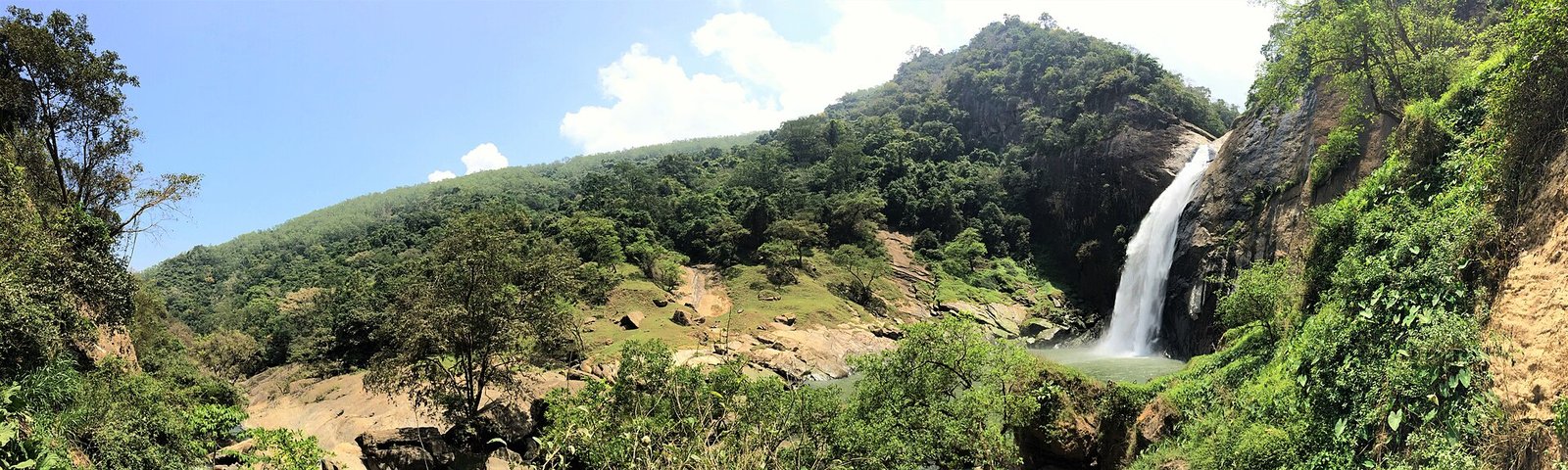
- Dunhinda Falls, near Badulla — the island's most theatrical waterfall, a 64-metre plume that drops into a pool and throws spray across the whole valley. It is a genuine 1–1.5 km walk in from the road, with a modest entry fee (around LKR 300–500 for foreign visitors) and a path that turns slick in rain. Go in the morning while the gorge is still in shadow. The reward is the noise: at full flow you feel it in your chest before you see it.
- Ravana Falls, Ella — 25 metres and about 6 km from Ella town, right on the main road, so you can combine it with a tuk-tuk run to the Nine Arch Bridge. Best after rain, when it becomes a wide curtain rather than three thin threads. Go before 9am if you want the pool to yourself; the bus-route traffic arrives mid-morning.
- St Clair's Falls and Devon Falls, Talawakelle — the twin viewpoints on the Hatton road, known locally as the "Little Niagara". You see both from the roadside between Nanu Oya and Hatton, which makes them the ideal train-journey stop: get off at Talawakelle, walk five minutes, and catch the next train or a bus onward. St Clair's is the taller at 80 metres; Devon's 97 metres is the photogenic one when it is running.
- Bomburu Ella, near Nuwara Eliya — the widest waterfall in the country and the one most travellers have never heard of, roughly 15 km from Nuwara Eliya on the Udupussellawa road. It needs a moderate walk in through farmland and forest, so allow half a day and wear real shoes. Because it lacks a tour-bus car park, the crowd profile is completely different.
- Laxapana and Aberdeen Falls, Hatton — for anyone who wants the wild version. Laxapana is the fall that feeds the hydro scheme and is visited mostly by Sri Lankan travellers; Aberdeen is a short, steep walk off the Ginigathhena road. Both need a driver who knows the turnings, and neither has facilities. This is the day for people who came for forest, not for queues.
- Bopath Ella, Ratnapura — the accessible one on the Colombo–Ratnapura side, so it fits neatly into a gem-country or Adam's Peak leg rather than the classic hill loop. Shaped like a bo leaf, and busy with local day-trippers at weekends, which is either the charm or the problem depending on your mood.
- The walk itself, not just the fall — the reason guests remember Dunhinda and Bomburu rather than the roadside cascades is the twenty to forty minutes of tea estate, bamboo and bird noise on the way in. Budget the time for the approach; it is half the experience.
Getting around
There is no public transport that reaches waterfalls well, and this is the single biggest planning fact. The realistic options:
- Tuk-tuk for the day — LKR 4,000–7,000 (roughly USD 13–23) for a half-day around Ella to Ravana Falls, Nine Arch Bridge and one or two smaller falls, negotiated as a package rather than per kilometre. Always agree the price and the stops in writing (a phone photo of the list works) before you set off.
- Private car and driver — USD 55–85 per day for the vehicle, which becomes excellent value the moment you are two or more people going to Dunhinda, Bomburu or the Hatton falls. The hills are slow: 40 km can take two hours, so a "day trip" is really a four-stop loop.
- Train, for the Talawakelle pair only — the Kandy–Nanu Oya line passes Talawakelle, so Devon and St Clair's are the one waterfall stop you can genuinely do on the railway. Second-class reserved from Kandy to Nanu Oya or Talawakelle costs a few hundred rupees; check the timetable the day before because the famous trains sell out.
- On foot, locally — Ravana Falls is a walkable or short tuk-tuk ride from Ella; the small falls around Nuwara Eliya's Lake Gregory are walkable from town. Everything else needs wheels.
- What to avoid — accepting a "waterfall tour" from a hotel desk at three times the street rate without asking what is included; paying a "guide" who materialises at the trailhead and demands a fee for a path that is signposted; and attempting a hillside trail in flip-flops after rain. Waterfalls are the one place on the island where the ground genuinely fights back.
What to budget
A waterfall day is one of the cheapest days you will spend in Sri Lanka, because the attractions themselves are almost free. An honest per-person breakdown for a hill-country waterfall day:
- Accommodation: USD 18–45 per night for a good hill-country guesthouse or small hotel; USD 60–120 for the polished boutique places. Ella and Nuwara Eliya both have strong mid-range stock, so this is not a budget-only day.
- Meals: USD 6–12 total for a rice-and-curry lunch and a guesthouse dinner; add USD 2–4 for tea and short eats. Hill-country food is cheaper than the coast and considerably better than the hotel buffet.
- Activities: near zero. Entry is free at Ravana, St Clair's, Devon, Aberdeen and Bopath; Dunhinda charges a small foreign-visitor fee in the region of LKR 300–500; Bomburu has a small local ticket. Budget USD 2–5 for the day and consider parking or a donation to a temple trailhead.
- Transport: the whole cost. A tuk-tuk half-day is USD 13–23; a full day with a car and driver is USD 55–85 per vehicle. Split three ways with a couple of friends and the day costs less than a single entrance fee at a major site.
- Total: roughly USD 45–90 per person for the day including a night's stay, or USD 20–35 if you are already based in Ella or Nuwara Eliya and just need the wheels. Rain jackets, dry bags and decent shoes are the only real "extras", and you should already own them.
WATCH OUT FOR
- Dry-season disappointment. A waterfall in a dry month can be a dribble over bare rock. The falls look best during and directly after the local monsoon, so check which side of the island you are on: the south-west hills run wet from May to September, the eastern and Uva side from October to January. If a fall looks thin in your photos from three weeks ago, plan around it.
- Flash floods in the gorge. Rain falling upstream reaches a narrow gorge within minutes. If the water turns brown and rises fast while you are on the rocks, climb out and stay out. This is the genuine risk at Dunhinda and Bomburu, and it is not a hypothetical.
- Slippery rock and no handrails. Most trails have rough steps, wet clay and gaps. Sandals are the commonest cause of a ruined day. Wear shoes with grip and take the descent as slowly as the ascent.
- "Guides" who appear at the trailhead. At several popular falls, someone will join you uninvited, walk ahead, then ask for a guide fee. There is nothing wrong with hiring a local guide — do it deliberately, at the entrance, for an agreed price, not by ambush halfway up.
- Parking and "convenience" charges that grow. Unofficial parking fees, "shoes holding" and impromptu viewing-platform tips are common at the roadside falls. Keep small notes, ask the price first, and remember that paying is always optional at a public waterfall.
- The bathing temptation. Swimming is genuinely dangerous at most falls because of submerged rocks and undercurrents, and a number are sacred or tied to a temple. Watch what local families do, and never dive into a plunge pool you cannot see the bottom of.
- Leeches in the wet hills. Bomburu, Laxapana and the Uva forest trails have leeches after rain. Long socks, trousers tucked in, and a little repellent solve it entirely. It is not a reason to skip the walk.
- Photo-spot congestion at the famous names. Ravana Falls and the roadside Talawakelle viewpoints get busy from mid-morning into late afternoon. Before 9am or after 4pm is a different place entirely, and the light is better too.
- Waterfalls sold as "attractions" with a two-hour detour. The pattern to watch is a driver or agent bundling a distant fall into a long transfer day. If the waterfall is a stop on the way to somewhere else, it is a bonus. If it is the reason for a three-hour round trip in the heat, it usually is not.
- Weather that closes the road instead. In heavy monsoon the hill roads can be blocked by landslips or washouts, and trails can be shut by local authorities. Ask at your guesthouse in the morning; the people who live on the road know before anyone else.
Good to know
- Time of day beats time of year. Morning gives you shadow, low light and empty pools; early evening gives you warm light and few people. The 11am–3pm window is the worst of both.
- Two falls, one day, is the right number. One short roadside stop plus one proper walk. Three or more and you spend the day in the vehicle.
- Chase rain, not sunshine. Counter-intuitively, a rainy hill-country morning is your best waterfall day. Full flow, dramatic mist, no crowds — and the tea estates look better too.
- Dress for the temple. Several falls sit inside or beside a temple or shrine, and shoulders and knees covered is expected. Carry a light sarong; it doubles as rain cover.
- Bring a dry bag and a change of footwear. Spray at Dunhinda soaks you regardless, and the walk out is cold once you stop moving.
- Book hill-country stays two or three nights, not one. The waterfalls, tea estates and viewpoints are spread across a small region; moving hotels every night costs you the very mornings that make the area worth visiting.
- Cash, not cards. Trailhead fees, tuk-tuks and small tea shops are cash. Keep LKR 2,000–5,000 in small notes for a waterfall day.
Where to stay
- Fern Hill Cabins, Ella (9.76/10 · 469 reviews) — The best-reviewed quiet address in Ella, with cabin-style rooms set back from the town's main strip. Reviews single out the calm and the garden, which matters when you are getting up before dawn for the falls and the Nine Arch Bridge.
- Guest Inn Avendra, Ella (8.3% of reviews mention peace) — The highest peace-density of the Ella guesthouses in our corpus, with hosts who consistently arrange onward transport. Practical base for a tuk-tuk waterfall half-day.
- Olinda Galle (9.76/10 · 597 reviews) — not a hill property, but the same operator's formula and the best-reviewed quiet stay in Galle; include it if your trip pairs the hills with the fort at the end. Reviews credit the small team and the sense of being looked after.
- Golden Rock Retreat, Sigiriya (9.98/10 · 479 reviews) — The highest-rated high-volume property in our entire corpus. If your route goes north first, this is where to spend the Cultural Triangle nights before heading up into the waterfall country.
- Still Waters Artistry, Negombo (9.93/10 · 722 reviews) — The largest-sample quiet stay on the island and the ideal first or last night, with hosts who organise drivers. Useful when you want a waterfall excursion arranged before you have learned the local prices.
- Ginganga Lodge (15.1% of reviews mention peace) — A river-and-forest property in the southern hills with one of the highest peace densities we recorded. A good add-on night for anyone doing the Ratnapura waterfalls rather than the Uva ones.
- Lankavatara Ocean Retreat & Spa, Tangalle (9.59/10 · 490 reviews) — The coastal counterweight: 41 peace mentions, zero crowd mentions, on a stretch of coast that records no bar noise at all. Book it as the decompression stop after the wet hills.
All figures above are drawn from the same 353,633-review dataset we use across BYC's travel data studies, updated September 2026. Property-level scores use only properties with 300+ reviews; regional percentages count all reviews in that region.
The best waterfall day in Sri Lanka is not the one with the longest list. It is the one where you left early, picked a fall with water in it, walked in past the tea bushes, and stood in the spray for twenty minutes without checking your phone. Choose two, go when it rains, and the hills will give you a day that no screenshot ever will.
Have a specific question about your Sri Lanka trip?
Ask BYC at byc.lk — free, honest, no upsell. Ever.
Ask BYC Your Question →