What a Sri Lanka Hotel Review Title Says About the Score
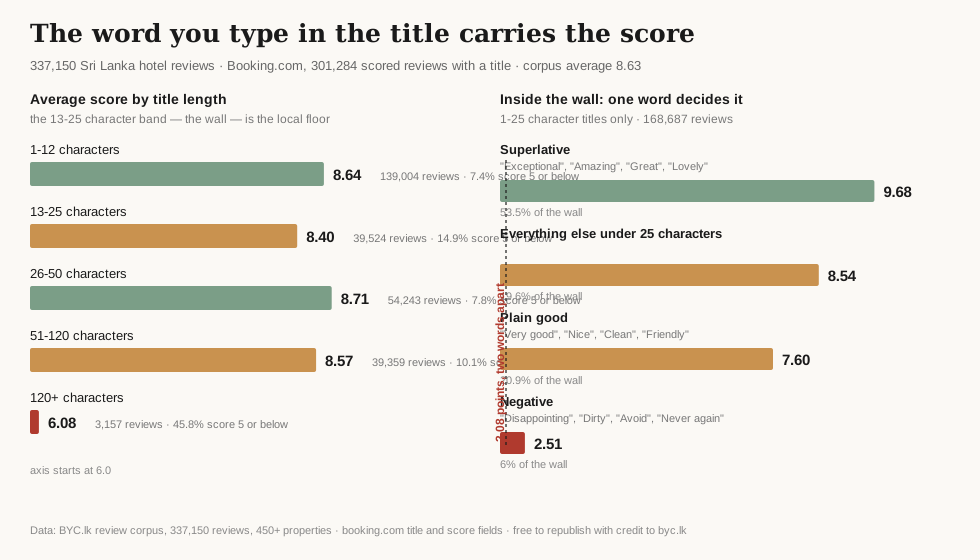
When you shortlist a hotel you read a score: 8.6, 9.2, 7.4. It looks like a measurement, and the platform presents it as one. But a score is the end of a process a guest went through in about four minutes, and one step of that process is typing a title. We counted what people type there, across 301,284 Booking.com reviews of Sri Lanka hotels, and the title turned out to predict the score more strongly than almost anything else in the data.
The short answer
This is not a story about fake reviews. It is a story about a scale that partly measures effort: how much a guest cared, how good their English is, whether they were writing for the hotel or for the next traveller. Once you know the shape of it, you can read a score the way an experienced traveller does — and a 7.9 stops looking like a bad hotel.
How we measured this
The corpus carries the review title as a separate field, alongside the score. That is the whole method: group reviews by the length and the wording of the title they carry, then look at the scores inside each group. No sentiment model, no AI reading, no sampling — just the same two fields the platform shows you, counted across every scored review we hold.
Two things make this a fair test rather than a curiosity. First, the 13-25 character band — where nearly all human-written short titles land — holds 39,524 reviews on Booking.com, which is far too many for the result to be a fluke of one city or one property. Second, the same platform carries a second, completely independent source of short titles: Agoda, whose reviewers are prompted separately. Where the Agoda sample is big enough to test a claim, we test it, and we say when it is not.
The score by title length
Sort every Booking.com review by how long its title is and the average does not rise smoothly. It dips, recovers, and then falls off a cliff at the very top.
| Title length | Reviews | Share of all | Average score | Score 5 or below | Average review body |
|---|---|---|---|---|---|
| 1–12 characters | 139,004 | 46.1% | 8.64 | 7.4% | 25 words |
| 13–25 characters | 39,524 | 13.1% | 8.40 | 14.9% | 42 words |
| 26–50 characters | 54,243 | 18.0% | 8.71 | 7.8% | 49 words |
| 51–120 characters | 39,359 | 13.1% | 8.57 | 10.1% | 49 words |
| 120+ characters | 3,157 | 1.0% | 6.08 | 45.8% | 1,258 words |
Three separate things are happening in that table, and only the middle one is surprising.
The 13–25 character band is the local floor. "Good", "Very good", "Disappointing", "Nice place", "Exceptional" — a title long enough to have an opinion, short enough that the opinion is the whole thing. That band scores 8.40, against 8.64 for the one-word titles above it and 8.71 for the descriptive titles below it, and it is the band with the second-highest share of poor scores (14.9%), behind only the essays. It is the point where a review carries a verdict without carrying any evidence.
The essays at the top are not a style choice. Of the 3,157 titles over 120 characters, 85.5% belong to reviews whose body runs past 800 words — the title field has been used to hold the entire review. They are overwhelmingly complaints, averaging 6.08 with 45.8% scoring 5 or below — the only group in the corpus whose average is below 7. So the rule is not "long titles are written by unhappy people". It is narrower and more useful: when someone uses the title to hold the whole story, the story is usually bad. On Agoda, whose prompt does not encourage that, the same band is 10 reviews — which is exactly why we do not present this as a general law about human beings, only as a fact about this platform's form.
The middle is unremarkable. Descriptive titles of 26–50 characters — "Lovely 3 night stay in Sigiriya" — score 8.71, marginally above average. A title that states what the stay was correlates with a review that is about the stay.
Inside the wall: one word decides two points
The 1–25 character band holds 168,687 English-language titles. Split them by the kind of word that does the work — exclusive buckets, so the shares add to 100% — and the spread is enormous.
| What the title says | Reviews | Share of the wall | Average score |
|---|---|---|---|
| Superlative — "Exceptional", "Amazing", "Great", "Lovely" | 90,227 | 53.5% | 9.68 |
| Plain good — "Very good", "Nice", "Clean", "Friendly" | 35,318 | 20.9% | 7.60 |
| Everything else (place names, names, unclassifiable) | 33,067 | 19.6% | 8.54 |
| Negative — "Disappointing", "Dirty", "Avoid", "Never again" | 10,075 | 6.0% | 2.51 |
The top and bottom rows are not a surprise. A person who types "Disappointing" is telling you the score before they give it, and 2.51 for that group is the corpus confirming it. What is worth your attention is the 2.08-point gap between the top row and the second, because those two groups are the same reviews in every meaningful sense: a satisfied guest, a short title, a hotel that did its job.
The difference is vocabulary. "Exceptional", "Fabulous", "Superb", "Perfect" are not everyday words, and people choose them when they are writing something a bit like a thank-you note. "Very good", "Nice", "Clean" are the words of someone writing a booking summary — accurate, unemotional, and scored roughly two points lower for it.
Why this matters when you are choosing a hotel
Because the number you are ranking hotels by is partly a measure of how enthusiastically the last 200 guests happened to phrase their titles. Two properties with an identical standard of service can sit a full point apart on the platform because one attracts guests who write "Exceptional" and the other attracts guests who write "Very good" — business travellers, families on a budget, people for whom the stay was simply fine.
What follows from that is not "ignore the score". It is three habits, and they are cheap:
Read the distribution, not the average. A 9.2 made of mostly 9s and 10s is a different hotel from a 9.2 made of 10s and a scatter of 6s. The average hides that; the histogram does not.
Read the lowest reviews and the longest ones, in that order. A 1-star review with a 60-word title and a hundred-word body is evidence. A 1-star review that says "Bad" is a mood. In our corpus the 120-character titles are the essays, and they are the closest thing to a full account that a review page contains.
Compare within one platform and one era. Scores are not portable between sites, and they are not portable across time either — our own cross-platform analysis of 314,070 reviews found Booking.com's Sri Lanka average stepping up by two points in a single month in April 2025 while Agoda, on the same hotels, did not move. A 7.9 from 2024 and a 7.9 from today are not the same hotel.
What this does not say
It is not evidence of fake reviews. Nothing in this analysis requires dishonesty. A vocabulary effect appears in honest reviews written by honest guests, because the words people choose vary by country, by English fluency and by temperament. In fact the pattern would vanish if reviews were fabricated — a bought "Exceptional" would not come with the measured 9.68 average it earns here, since the score is set separately from the title.
Title length is not a quality signal in itself. The 120+ band is a form artefact, not a psychological law, and Agoda's 10 rows in that band make the point better than any caveat: same guests, different form, no wall of essays.
Our buckets are crude on purpose. "Not" appears in both "Not recommended" and "Not bad", and a 25-character title is often a place name or a surname. That is why the table shows a "everything else" row of 33,067 instead of forcing every review into a story. The two rows that carry the argument — superlative and plain good — are made of unambiguous words, and their sample sizes are 90,227 and 35,318.
And the score still mostly measures the hotel. The corpus average is 8.63, and the regional spread is real: in 2026 Kosgoda averages 9.49 across 234 reviews while Mount Lavinia averages 8.16 across 538. The claim here is narrower and stronger: on this platform, at the margin where your shortlist lives, the phrasing of a title is worth about two points, which is enough to reorder a shortlist. Treat it as a reason to read past the average, not as a reason to distrust the number.
The practical version
When you look at a Sri Lanka hotel score this week: ignore the first decimal, look at how many reviews the top and bottom each have, read three of the longest low reviews, and remember that "Very good" is not a complaint. If you want the numbers behind that advice in a different form, our study of what actually ruins a Sri Lanka trip ranks the mistakes that do real damage, and the rating-scale analysis explains why a score from last year is not comparable with one from this year.
Have a specific question about your Sri Lanka trip?
Ask BYC at byc.lk — Free and honest. Some links are affiliate links and never change our advice.
Ask BYC Your Question →