What Actually Ruins a Sri Lanka Trip: 315,523 Reviews Ranked
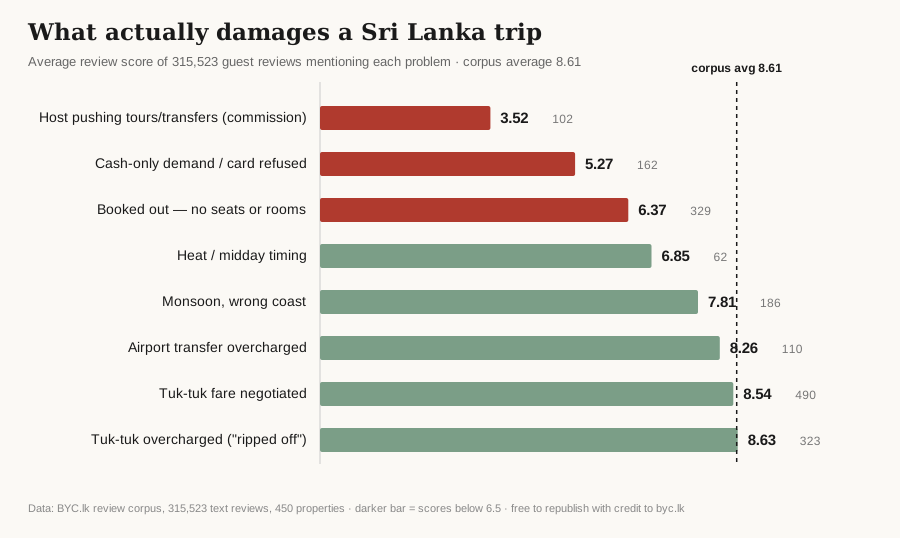
Ask a forum what ruins a Sri Lanka trip and you will get the same four answers: the tuk-tuk drivers will rip you off, it will rain, it will be too hot, and you should not trust the touts. Then we went and counted. Across 315,523 guest reviews covering 450 properties, the complaints travellers are warned about most are almost invisible — and the one that does the most damage is the one almost nobody warns you about.
The short answer
Read the rest of this page as a ranking of mistakes by measured damage, not by how often they appear in warning lists. Two rules fall out of it, and they are the two we would give someone getting on the plane tomorrow: book the excursion you want, before you arrive, from someone who is not your host, and never let the only record of your booking be a message thread.
How we measured this
We build the review corpus for our destination pages, and for this page we ran nine narrow phrase patterns across every review with text — not sentiment analysis, not an AI judgement, just explicit language that a reviewer would only write if the thing actually happened to them. Each pattern is deliberately specific so that it does not catch ordinary mentions: the tuk-tuk overcharge pattern requires a tuk-tuk reference and an overcharge word within the same 120 characters.
For each pattern we recorded three things: how many reviews match, what those reviews average out of 10, and how much more common the pattern is among 1–4 reviews than among 9–10 reviews. That last figure is the useful one, because it says how much a given complaint tends to destroy a stay rather than merely occur during it. It is the same method we used for the safety study and the wifi data, and it has one honest limitation, stated in full at the bottom of this page.
Ranked by damage: the table nobody publishes
| What the reviews describe | Reviews | Avg score | vs corpus | 1–4 reviews | 9–10 reviews | Lift |
|---|---|---|---|---|---|---|
| A host pushing tours / transfers for commission | 102 | 3.52 | −5.09 | 0.33% | 0.01% | 42.4× |
| Cash-only demands, no ATM, card refused | 162 | 5.27 | −3.34 | 0.38% | 0.03% | 15.0× |
| Booked out — no seats, rooms or tickets left | 329 | 6.37 | −2.24 | 0.54% | 0.08% | 7.1× |
| Heat — midday timing, sunburn, "too hot to" | 62 | 6.85 | −1.76 | 0.09% | 0.02% | 6.1× |
| Monsoon / wrong coast / out of season | 186 | 7.81 | −0.80 | 0.16% | 0.06% | 3.0× |
| Airport transfer or taxi overcharged | 110 | 8.26 | −0.35 | 0.08% | 0.04% | 2.2× |
| Tuk-tuk fare negotiated / price discussed | 490 | 8.54 | −0.07 | 0.29% | 0.17% | 1.7× |
| Tuk-tuk overcharged / "ripped off" | 323 | 8.63 | +0.02 | 0.18% | 0.12% | 1.5× |
Three things in that table are worth sitting with. The tuk-tuk overcharge line — the single most-written-about hazard in every Sri Lanka guide ever published — sits above the corpus average, which means a review that mentions being overcharged by a tuk-tuk is, on average, a review of a stay someone enjoyed. It is a 400-rupee annoyance. It stings for ten minutes and it does not touch the memory of the trip.
The 30-point spread between "fare negotiated" (8.54) and "commission pushed" (3.52) is the whole page in one line. The difference between the traveller negotiating and the traveller being steered is not the money. It is who is doing the steering.
Mistake 1 — Letting your host arrange your excursion
This is the finding we did not expect, and it is not close. Of 102 reviews describing a commission arrangement, the average score is 3.52 — the lowest of any pattern we tested, well below even cash problems. And the pattern is a destroyer: it appears in 0.33% of 1–4 reviews and 0.01% of 9–10 reviews.
What it looks like when it goes wrong, in guests' own words:
"For the last they were not happy when we booked whale watching through my friend because thay do it by themselves with a commission. Please dont use this place because its totally a scam." — review of a Mirissa property
"He also asked me to cancel the booking so that he doesn't have to pay the commission to the booking.com." — review of an Unawatuna property
"commission sur taxis … bref on cherche à faire de l'argent" — "a commission on taxis … basically they're out to make money" — review of an Unawatuna property
Notice that none of these is really about the excursion. The first guest had already booked with someone they trusted and the host resented it. The second lost the protection of the booking platform so the property could keep the margin. The third is the tell: once a guest suspects the recommendation is paid, every other recommendation on the trip becomes suspect — the restaurant, the driver, the "best" safari operator. That is why it scores lower than a broken room. A broken room is one bad night. This is a broken compass.
The practical rule costs you nothing: arrange the thing you actually want before you arrive, from a company with a name and a review page, and tell your host you have already booked it. A generous host will be delighted — it is less work for them. A host who is visibly annoyed has just told you what you needed to know about the rest of your stay.
Mistake 2 — Cashing out of your own protection
162 reviews describe cash-only demands, a dead ATM, or a card that would not work, and they average 5.27 — a 3.34-point gap and the most damaging pattern after commission. Read the quotes and the mechanism becomes obvious: the problem is not the cash. It is that the cash removed the evidence.
"They asked … to pay right away after arriving and in cash … when we tried to cancel or reschedule the booking, they were really reluctant and not entirely honest about the prices." — review of an Unawatuna property
"You had to pay cash. The price was presented in USD not rupees but you had to pay rupees. I felt like we were getting ripped off." — review of a Mirissa property
Both quotes are about disputes that only became unwinnable after the payment left the card system. Sri Lanka's own water price ceiling is a good illustration of how much the country has formalised: a 1.5-litre bottle is capped by gazette order at LKR 150 (about 45 US cents), and bottled water is available everywhere. A "cash only, the card machine is broken" line from a mid-range property is not a fact about Sri Lanka's banking system. It is a negotiating position. Card machines work in Colombo, Kandy, Galle and at every airport counter; if one "does not work" at the moment of payment, pay the part you have in cash and put the rest on deposit later, or use a transfer that leaves a trail.
Mistake 3 — Arriving without a seat or a room
329 reviews mention being booked out — no seats, no rooms, no tickets — and they average 6.37. This is the most avoidable item on the list, because it is pure timing. Reserved train seats on the hill line release exactly 30 days ahead and the scenic leg (Nanu Oya–Ella) sells out the same morning; the booking guide covers the mechanism. Rooms in Mirissa and Ella over the late-December peak behave the same way.
The reviews also show the second-order cost: a guest who cannot get the seat they wanted ends up on a six-hour road transfer they did not budget for, which then turns into a heat complaint. Which brings us to the two patterns that everyone worries about and the data says are minor.
Mistake 4 — Treating heat and monsoon as planning afterthoughts
These rank in the middle and their damage is medium rather than severe: heat mentions average 6.85 and monsoon mentions 7.81 against 8.61. Neither is a scam. Both are timing, and both are trivially fixable before you leave. Heat shows the third-highest lift on the board (6.1×), because a climb at 11am in April is a genuinely miserable thing rather than a slightly annoying one. The monsoon pattern — "out of season", "rained all day", "wet season" — is a coast-and-month mismatch, which is entirely a planning problem and has a documented fix: our month-by-month guide and the coastal split in December answer it directly.
What this does not say
Three limits, stated plainly, because a data study without them is marketing.
Reviews are written by hotel guests. That is the sample. It is very good at catching things that happen inside or around a stay — a host's excursion commission, a cash demand at check-out, a tuk-tuk waiting at the gate — and it is structurally blind to anything that happens on a mountain, a train or a road far from the property. So this page can tell you tuk-tuk overcharging is minor in the context of a stay. It cannot tell you the average price at a specific junction, and it should not be read that way. For that, use the fare guide.
A review that mentions a pattern is not a review ruined by it. A separate cut of the same corpus shows that on Booking.com the wording of a review title alone moves the score about two points, which is the same warning from the other direction: the score and the words are two different measurements, and the words are the ones with evidence in them. That is exactly why we show the average score next to every row instead of only the count. A tuk-tuk complaint averaging 8.63 is a review of a good trip with one bad ten minutes in it, and the table would be dishonest if it reported the count and not the score.
Nine patterns is not every pattern. These are the nine that the corpus could support with enough reviews to mean something. Absence of a pattern here is not evidence that it never happens — it is evidence that it does not happen in hotel reviews often enough to measure, which for a traveller is a distinction without much practical difference.
If you only do two things
One. Book your excursions and transfers before you arrive, with a company whose name is on a review page, and say so at check-in. Your stay should not be the place you find out how your host earns.
Two. Pay the property through the platform you booked on, in the currency you were quoted, and get a receipt with the company name on it. Every single review quoted in Mistake 2 is a dispute that became unwinnable at the moment the evidence stopped existing.
Everything else on this page — the tuk-tuk, the heat, the rain — you can fix on the morning it happens. Those two you cannot fix afterwards.
Have a specific question about your Sri Lanka trip?
Ask BYC at byc.lk — Free and honest. Some links are affiliate links and never change our advice.
Ask BYC Your Question →