Sri Lanka Hotel Ratings Changed in 2025 — What 314,070 Reviews Show
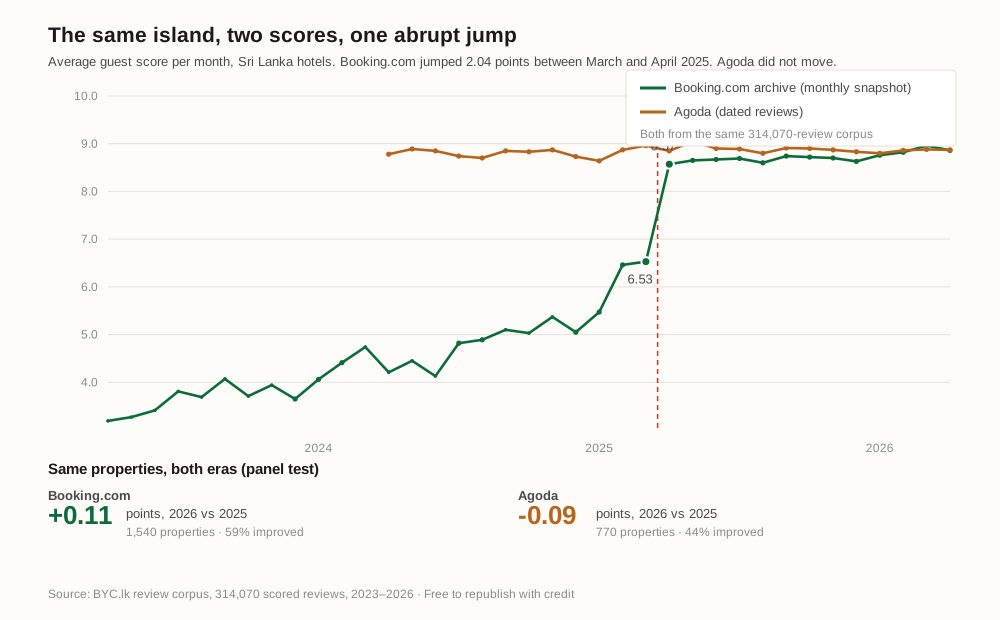
Every Sri Lanka hotel guide quotes guest scores. Almost none of them check whether the scores mean the same thing they did two years ago. We had 303,084 reviews spanning February 2023 to June 2026, so we checked — and found a jump of 2.04 points in a single month that no hotel on the island earned.
The short answer
The practical consequence is small but real: treat any Booking.com score as a relative ranking within its own era, and never compare a pre-2025 score to a 2026 score as if the two were the same scale. A hotel sitting at 7.9 in 2024 would very likely sit near 9.0 today without anything changing except the site.
How we found it
We build the review corpus behind our hotel pages, and one property of that corpus turned out to be a gift: it carries two separate sources on two different date formats. Booking.com reviews arrived as a monthly archive — "March 2025", "April 2025" — while Agoda reviews carry a real review date, "2025-11-03". Two ways of storing the same kind of opinion about the same hotels in the same country.
So we plotted both by month. The chart below is the entire finding in one image: the green line steps up and never comes back down, the brown line stays flat for three straight years.
| Year | Booking.com reviews | Booking.com avg | Agoda reviews | Agoda avg |
|---|---|---|---|---|
| 2023 | 2,772 | 3.70 | — | — |
| 2024 | 6,196 | 4.71 | 11,246 | 8.79 |
| 2025 | 131,317 | 8.60 | 33,195 | 8.86 |
| 2026 (to June) | 100,935 | 8.84 | 17,423 | 8.85 |
The Booking.com column is not a gradual drift with a bad year in it. It is a step: 3.70 in 2023, 4.71 in 2024 up to March 2025, then 8.57 in April 2025 and a flat band between 8.4 and 8.8 every month since. Lines that smooth themselves out across a year look like visitor mix. A line that hops 2 points in one month and then coasts does not.
But maybe 2025 was just a good year for Sri Lanka
That is the obvious objection, and it is the reason this page exists — because we can test it rather than argue about it. Two tests, both using properties that appear in both periods so that the property mix cannot do the work.
Test one: the panel. Take every property with at least three distinct review months in April–December 2025 and at least three in 2026 — 1,540 properties on Booking.com, 770 on Agoda. Compute each property's average in each era, then average the property averages. Now the same hotels, the same island, the same year pair:
| Panel | Properties | 2025 avg | 2026 avg | Change | Share that improved |
|---|---|---|---|---|---|
| Booking.com | 1,540 | 8.72 | 8.83 | +0.11 | 58.9% |
| Agoda | 770 | 8.94 | 8.85 | -0.09 | 43.8% |
The Booking.com panel gains 0.11 points; the Agoda panel of the same hotels in the same years loses 0.09. If Sri Lanka had genuinely got better in 2026, both panels would tilt the same way. They don't. They tilt in opposite directions, which is exactly what a method change on one side looks like and not what a real-world improvement looks like.
Test two: the region split. Region scores come from Booking.com, and the pre-2025 versus post-2025 difference in the smallest-sample places is comic. Weligama goes from 5.88 to 8.67, Dambulla from 6.31 to 8.98, Polonnaruwa from 6.73 to 8.95. Weligama did not become a 2.79-point-better beach town between 2025 and 2026; Weligama became a town whose booking site started asking a different question.
The cleanest way to see it is where the two platforms disagree today, after both have settled into their current method — because that is what a real ranking difference between two sites looks like. Across the 27 regions with at least 300 reviews on each platform, the gaps run from -0.17 (Unawatuna, Agoda minus Booking.com) to +0.43 (Trincomalee). Whole points. No method change, just two different samples of the same places:
| Region | Booking.com avg | Agoda avg | Gap |
|---|---|---|---|
| Unawatuna | 8.82 (6,538) | 8.65 (836) | -0.17 |
| Trincomalee | 8.48 (6,274) | 8.91 (1,166) | +0.43 |
Trincomalee sits 0.43 points apart between the two sites today, and it is the same town. That is not evidence that one site is wrong; it is evidence that "the score" is a property of a platform, a sample and a date, not of the hotel.
What this does not say
It does not say the reviews are fake. Nothing here suggests anyone bought a score. A rating-scale or prompt change moves millions of honest reviews at once, which is precisely why it is visible in aggregate and invisible in any single review. The reviews in the corpus are the same reviews as before; what changed is the dial they were recorded on.
It does not tell you which site is "right". Booking.com post-April-2025 and Agoda are both internally consistent. Within one platform and one era, the score still ranks hotels correctly. That is the whole practical rule.
It cannot date the change any more precisely than a month. Booking.com dates arrive as a monthly archive, so April 2025 is the boundary of what the data can resolve. The step is somewhere between the March and April snapshots.
One layer further down, the same corpus shows that an individual score is also shaped by how a guest phrased the review title: short titles using a superlative average 9.68 against 7.60 for plain approving words like “Very good”. See why two points sit inside one word, because it is the other half of reading a score honestly.Agoda is smaller here. 33,195 Agoda reviews against 131,317 Booking.com in 2025, which is why the panel test rather than the raw yearly average is the load-bearing evidence.
What to do with a score now
One. When you compare hotels, compare them on the same site in the same era. A 9.1 and an 8.9 from 2026 Booking.com are meaningfully different. A 7.9 from 2024 and an 8.9 from 2026 are not comparable at all — and the 2024 hotel may well be the better room.
Two. Read the words, not the number. This is the advice every guide gives and this page finally provides the reason: on this corpus the text of a review is stable across the break while the score is not. Our study of what actually ruins a trip works entirely off phrase patterns for exactly this reason — "the card machine is broken" means the same thing in 2024 as in 2026, and 8.6 does not.
Three. If a score is the only thing you have, ask what year it is from. Score bands on this island now carry a hidden era, and an honest reading of any pre-2025 Booking.com number subtracts roughly one to two points before comparing it with today's.
Why we published this at all
We would rather tell you the numbers we quote need a caveat than quietly quote them as if they were absolute. Every destination score on this site comes from this corpus, and our pages link back to this one so that a reader who wants to check the arithmetic can. The method scripts, the monthly series and the property panel are all in the repository; the chart is a single SVG, free to republish with credit.
Have a specific question about your Sri Lanka trip?
Ask BYC at byc.lk — Free and honest. Some links are affiliate links and never change our advice.
Ask BYC Your Question →